Quick Answer
PFAS-free cookware regulations expanded significantly in 2025–2026, changing how non-stick cookware is manufactured, labeled, and sold. Several U.S. states now restrict or ban intentionally added PFAS in cookware coatings, while brands have shifted toward alternative surface technologies.
“PFAS-free” no longer means the same thing it did a few years ago. Understanding what changed helps buyers separate real material differences from marketing language.
What PFAS-Free Cookware Means Today (Simple Definition)
PFAS-free cookware generally refers to cookware where PFAS compounds are not intentionally added to the cooking surface during manufacturing.
However, the meaning varies depending on:
- regulatory definitions
- testing thresholds
- coating chemistry
Because PFAS refers to a large chemical family, “PFAS-free” does not always mean the same thing across brands or jurisdictions.
Why PFAS Became a Cookware Issue (Brief Context)
PFAS (per- and polyfluoroalkyl substances) are a large group of synthetic chemicals valued for their resistance to heat, water, and oil. These properties made them useful in non-stick cookware coatings for decades.
Concerns grew because:
- Some PFAS compounds persist in the environment
- Certain legacy PFAS were linked to bioaccumulation
- Manufacturing emissions, not normal cooking use, became the primary regulatory focus
It is important to clarify one point early:
PFAS regulation targets chemical presence and manufacturing practices — not sudden consumer danger.
Cookware did not become unsafe overnight. The shift reflects evolving environmental and material standards, not emergency consumer risk.
This distinction matters because fear-based framing has distorted how “PFAS-free” is discussed online.
What Actually Changed in 2025–2026
The most meaningful change was regulatory scope, not a single nationwide ban.
State-Level PFAS Restrictions Expanded
Beginning in 2025, several U.S. states implemented or activated laws restricting intentionally added PFAS in cookware and food-contact products. These laws typically focus on:
- Manufacturing composition
- Product labeling requirements
- Disclosure obligations
Importantly:
- These laws do not retroactively ban existing cookware
- They do not prohibit all fluorinated materials
- They vary by state in enforcement timing and scope
This means cookware availability and labeling can now differ depending on market and distribution channel.
“PFOA-Free” Is No Longer the Standard
Older cookware marketing emphasized “PFOA-free.”
That claim became obsolete because PFOA was phased out years ago.
In 2025–2026:
- “PFOA-free” alone no longer signals compliance
- “PFAS-free” now implies a broader material claim
- Some coatings still use fluoropolymers that fall outside specific bans
As a result, labels require interpretation, not blind trust. The most significant changes came from state-level regulations rather than a single federal ban.
PFAS Cookware Laws in the U.S. (2025–2026 Update)
The most meaningful changes to PFAS-free cookware in 2025–2026 came from state-level regulations rather than a single nationwide ban.
These laws focus primarily on intentionally added PFAS in cookware and food-contact materials, but they differ in scope, enforcement, and intent. Some states restrict or prohibit PFAS in cookware, while others emphasize labeling and disclosure.
This creates an important shift:
PFAS regulation is no longer theoretical—it now affects how cookware is manufactured, labeled, and sold across different markets.
At the same time, these laws share several common characteristics:
- They apply to new products entering the market, not cookware already in use
- They focus on manufacturing composition, not everyday cooking safety
- They target intentionally added PFAS, not trace or incidental presence
- They are not standardized across the United States
As a result, cookware availability and labeling may now vary depending on where a product is sold or distributed.
Understanding these differences helps explain why the term “PFAS-free” has become more visible—and more complex—since 2025.
Minnesota — PFAS Cookware Ban (Amara’s Law)
Minnesota implemented the most direct regulatory change affecting cookware through what is commonly known as Amara’s Law.
Beginning January 1, 2025, the state prohibits the sale and distribution of cookware that contains intentionally added PFAS. This applies to products entering the market within Minnesota, not to cookware already owned or in use.
The law focuses on:
- PFAS intentionally added during manufacturing
- Cookware and other food-contact products
- Products sold within the state’s retail and distribution channels
This distinction is important. The regulation does not require consumers to replace existing cookware, nor does it classify previously sold products as unsafe. Instead, it sets a forward-looking standard for how cookware must be manufactured and marketed.
Minnesota’s approach also establishes a broader timeline. The state has outlined a pathway toward wider PFAS restrictions across multiple product categories in the coming years, making cookware part of a larger regulatory shift rather than an isolated case.
As the first state to implement a clear restriction on PFAS in cookware, Minnesota effectively set a precedent. Other states have followed with variations of this model, but with different enforcement strategies and timelines.
Vermont — Expanded PFAS Restrictions (2026)
Vermont expanded its PFAS regulations to include cookware and other food-contact products as part of a broader consumer product policy framework.
Beginning in 2026, the state restricts the sale of products that contain intentionally added PFAS, with cookware falling under this expanded scope. Like Minnesota’s approach, the focus is on manufacturing inputs rather than consumer use.
Key characteristics of Vermont’s regulation include:
- Coverage across multiple product categories, including cookware
- Emphasis on intentionally added PFAS, not incidental presence
- Forward-looking enforcement targeting new products entering the market
Unlike a single-category ban, Vermont’s approach integrates cookware into a wider environmental and consumer safety strategy. This reflects a growing trend where PFAS is treated as a class of concern across product types, rather than an issue limited to specific industries.
For cookware buyers, the practical impact is similar to Minnesota:
- Existing cookware is not retroactively affected
- Product availability may vary by market
- Labeling and material claims may become more standardized over time
Vermont’s expansion reinforces the idea that PFAS regulation is evolving incrementally, with cookware included as part of a broader shift in manufacturing expectations.
Connecticut — PFAS Labeling Requirement (2026)
Connecticut took a different approach by focusing on product transparency rather than outright restriction.
Beginning in 2026, cookware that contains intentionally added PFAS must include clear labeling or disclosure, indicating the presence of these substances. Instead of removing products from the market, the regulation ensures that consumers are informed about material composition.
This approach emphasizes:
- Disclosure of intentionally added PFAS
- Labeling requirements at the point of sale
- Increased transparency across cookware categories
Unlike bans, labeling laws do not limit product availability. Cookware can still be sold, but manufacturers must provide clearer information about what is used in the cooking surface or coating.
This creates a different type of shift:
Buyers are expected to interpret labels rather than rely on assumptions.
In practice, this means:
- “PFAS-free” claims become more visible—but also more variable
- Products without PFAS labeling may still require closer evaluation
- Transparency improves, but interpretation becomes more important
Connecticut’s model reflects a regulatory path centered on informed decision-making, rather than restriction.
California — Proposed PFAS Cookware Ban (Vetoed)
California considered a more aggressive regulatory approach, proposing a ban on PFAS in cookware and other consumer products. However, the measure was ultimately vetoed, highlighting the complexity of regulating PFAS at scale.
The proposed legislation aimed to:
- Restrict cookware containing intentionally added PFAS
- Expand existing chemical safety frameworks
- Align cookware regulations with broader environmental policies
The veto did not reject PFAS concerns themselves. Instead, it reflected practical challenges related to:
- Manufacturing feasibility
- Supply chain limitations
- Economic impact on producers and retailers
This outcome is important because it shows that PFAS regulation is not uniform, even in states with strong environmental policies.
In practical terms:
- PFAS cookware is still legal in California
- No statewide ban currently applies to cookware
- Future proposals remain possible as regulations continue to evolve
California’s decision underscores a key point:
PFAS regulation is still developing, and differences between states are likely to persist rather than converge quickly.
PFAS Cookware Regulation Overview (By State)
The current regulatory landscape can be summarized by comparing how different states approach PFAS in cookware.
| State | Action Type | Cookware Affected | Effective Year |
|---|---|---|---|
| Minnesota | Ban | Yes | 2025 |
| Vermont | Restriction | Yes | 2026 |
| Connecticut | Labeling | Yes | 2026 |
| California | Proposed (Vetoed) | No | — |
This comparison highlights a key reality:
There is no single national standard for PFAS in cookware.
Instead, regulations vary by state, with different priorities:
- Some states focus on removal (bans)
- Others emphasize disclosure (labeling)
- Some are still evaluating future restrictions
For consumers, this means cookware products may:
- Differ by region or distribution channel
- Carry different labeling depending on where they are sold
- Reflect evolving compliance strategies from manufacturers
Understanding this fragmented landscape is essential when interpreting “PFAS-free” claims, since those claims often align with specific regional requirements rather than a universal definition.
Why “PFAS-Free” Does NOT Mean the Same Thing Everywhere
This is where confusion peaks.
“PFAS-free” can mean different things depending on:
- Jurisdiction
- Coating chemistry
- Whether trace fluorine is considered “intentionally added”
- Testing thresholds vs absolute absence
Some cookware marketed as PFAS-free:
- Uses ceramic-based sol-gel coatings
- Uses alternative polymer binders
- Avoids fluorinated compounds entirely
Other cookware:
- Uses fluoropolymers that are technically compliant
- Meets regulatory definitions but still involves fluorine chemistry
This does not automatically indicate deception — it reflects how broad the PFAS category is.
Understanding this nuance prevents buyers from equating:
“PFAS-free” = “risk-free”
or
“Contains PFAS” = “unsafe”
Neither conclusion is accurate.
What “PFAS-Free” Really Tells You
The term “PFAS-free” has become more visible since 2025, but it is often interpreted more broadly than intended.
At its core, the label describes what is not intentionally used during manufacturing, not how cookware performs over time.
In practical terms, “PFAS-free” indicates:
- PFAS compounds are not intentionally added to the cooking surface
- The claim aligns with specific regulatory definitions or testing thresholds
- The focus is on material composition, not usage behavior
What it does not guarantee:
- Higher heat tolerance
- Longer lifespan
- Better non-stick performance
- Resistance to wear or misuse
This distinction matters because cookware performance is driven by material structure and heat interaction, not by the absence of a single chemical group.
For example:
- A PFAS-free ceramic coating may still wear down with repeated high heat
- Stainless steel remains PFAS-free but requires technique to prevent sticking
- Carbon steel develops non-stick behavior through seasoning, not coatings
Understanding this helps prevent a common mistake:
Treating “PFAS-free” as a performance upgrade rather than a manufacturing attribute.
The label is useful when interpreted correctly—but misleading when used as a shortcut for safety, durability, or cooking results.
How PFAS Changes Affected Different Cookware Materials
Not all cookware materials were affected equally by PFAS-related changes. Understanding which materials rely on surface chemistry — and which do not — is key to making sense of post-2025 cookware claims.
Non-Stick Cookware (Traditional PTFE-Based)
Traditional non-stick cookware relied on fluoropolymer coatings because they delivered reliable release at relatively low thickness.
What changed:
- Some manufacturers reformulated coatings to remove intentionally added PFAS
- Others shifted product lines toward alternative non-stick technologies
- Labeling became more prominent, but also more inconsistent
What did not change:
- Non-stick cookware did not suddenly become unsafe
- Performance decline patterns remain the same
- Heat misuse still determines lifespan more than chemistry
In short, PFAS-free reformulation affects manufacturing inputs, not everyday cooking behavior. Buyers should still prioritize:
- Heat limits
- Coating thickness
- Cleaning habits
These principles are already covered in when to replace non stick cookware and maximum safe heat cookware materials.
Ceramic-Coated Cookware
Ceramic cookware saw the largest marketing shift during 2025–2026.
Why:
- Ceramic coatings typically avoid fluorinated compounds
- They fit cleanly into “PFAS-free” regulatory language
- Brands positioned them as safer alternatives
What matters in practice:
- Ceramic coatings rely on silica-based sol-gel layers
- They release well at moderate heat
- Longevity is limited by surface wear, not toxicity
Important clarification: PFAS-free does not mean maintenance-free.
Ceramic cookware still:
- Loses release performance over time
- Requires moderate heat discipline
- Benefits from rotation with other cookware
This aligns with findings in ceramic cookware explained and ceramic vs granite cookware.
Stainless Steel Cookware
Stainless steel cookware is structurally unaffected by PFAS regulations.
Why:
- It contains no surface coatings
- Cooking performance depends on heat control and oil use
- Longevity is mechanical, not chemical
As PFAS awareness increased:
- Stainless steel gained renewed attention
- Buyers seeking permanence gravitated toward it
- Misconceptions about sticking resurfaced
Stainless steel remains:
- PFAS-free by nature
- Stable under high heat
- Long-lasting when used correctly
The learning curve remains technique-based, not safety-based, as discussed in why food sticks to stainless steel and eggs sticking stainless steel.
Carbon Steel Cookware
Carbon steel occupies a middle ground:
- Naturally PFAS-free
- Develops non-stick behavior through seasoning
- Responds quickly to heat
PFAS regulations increased interest in carbon steel because:
- It avoids coatings entirely
- It offers non-stick performance without chemical layers
- It suits high-heat cooking
Tradeoffs remain:
- Requires seasoning maintenance
- Reacts poorly to prolonged acidic cooking
- Demands heat awareness
Carbon steel’s growing relevance fits with comparisons in carbon steel vs cast iron cookware and carbon steel vs non stick cookware.
Cast Iron (Bare and Enameled)
Cast iron was largely unaffected by PFAS changes because:
- Bare cast iron uses no coatings
- Enameled cast iron relies on glass-based enamel
Bare cast iron:
- Naturally PFAS-free
- Extremely heat tolerant
- Requires seasoning and rust prevention
Enameled cast iron:
- PFAS-free cooking surface
- Lower heat ceiling than bare iron
- Easier maintenance for acidic foods
The distinction remains about use case, not safety, as outlined in cast iron vs enameled cast iron and enameled cast iron cookware pros cons care.
Aluminum, Glass, and Copper
These materials were not directly targeted by PFAS restrictions.
- Aluminum concerns relate to surface coatings, not the metal itself is aluminum cookware safe for everyday use.
- Glass cookware remains chemically inert and PFAS-free by default glass cookware heat safety.
- Copper cookware behavior depends on its lining (usually stainless steel) copper cookware performance maintenance.
None of these materials required reformulation due to PFAS changes.
Related Material Guides
PFAS-free cookware is best understood in the context of how different materials behave in real cooking conditions. Each material achieves safety and performance through different mechanisms, not through labeling alone.
The following guides explore those differences in detail:
- Ceramic cookware explained — coating structure, wear patterns, and realistic lifespan
- Stainless steel cookware behavior — heat control, sticking mechanics, and long-term durability
- Carbon steel vs cast iron cookware — seasoning behavior, heat response, and maintenance tradeoffs
- Enameled cast iron cookware — surface stability, moisture retention, and cooking versatility
These material-specific guides provide a deeper understanding of how cookware performs beyond PFAS-related claims, helping connect regulatory language with real-world cooking behavior.
What Buyers Misinterpret About “PFAS-Free”
Several misconceptions became more common after 2025:
- PFAS-free does not mean zero risk
- PFAS presence does not mean unsafe cookware
- Label claims do not replace material understanding
- Manufacturing standards differ from cooking behavior
The most important safety factors remain:
- Heat control
- Surface condition
- Structural stability
These indicators are covered comprehensively in signs cookware not safe to use and how long should cookware last.
Should You Replace Existing Cookware Because of PFAS?
Most existing cookware does not need to be replaced immediately. PFAS regulation focuses mainly on manufacturing practices and environmental persistence, not sudden consumer risk from normal cooking.
Cookware replacement is usually recommended when:
- coatings are worn or damaged
- heat limits have been repeatedly exceeded
- food release performance has declined
In other words, replacement decisions should still be based on performance and wear, not fear of older cookware.
How to Evaluate PFAS-Free Claims Without Falling for Marketing
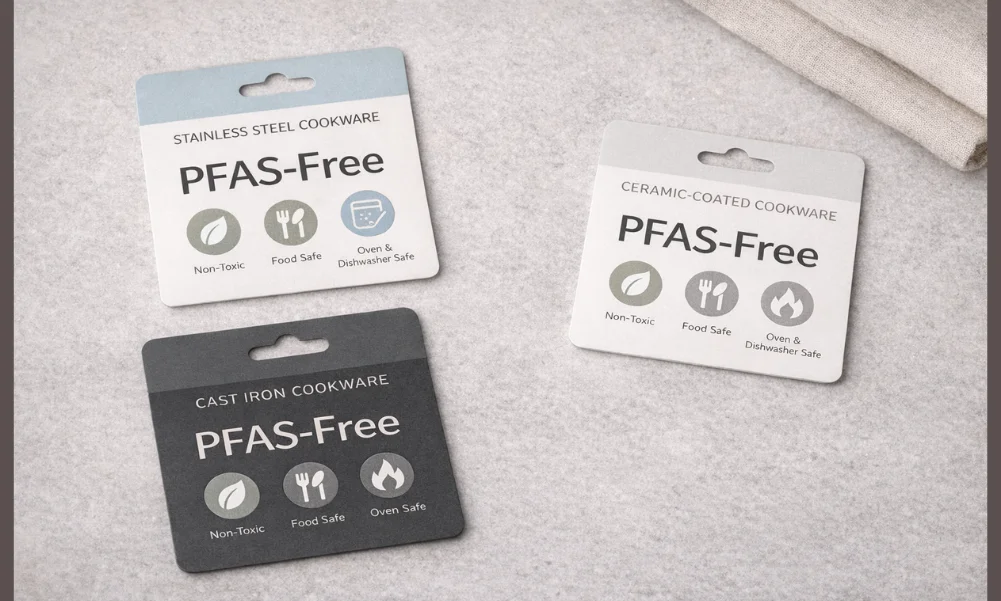
As PFAS language became more visible in 2025–2026, labels became louder—but not always clearer. Evaluating claims correctly requires separating regulatory language from cooking reality.
What “PFAS-Free” Actually Means on Labels
In most cases, “PFAS-free” indicates that:
- PFAS compounds are not intentionally added during manufacturing
- The claim applies to the cooking surface, not necessarily all components
- Compliance aligns with specific regional regulations, not universal standards
What it does not guarantee:
- Longer cookware lifespan
- Higher heat tolerance
- Better food release
- Zero chemical exposure under misuse
PFAS-free status describes what is absent, not how cookware behaves under heat, abrasion, or time.
Certifications That Matter (and Those That Don’t)
Some certifications provide meaningful baseline reassurance. Others are primarily marketing signals.
More useful indicators:
- FDA food-contact compliance (baseline safety)
- California Prop 65 disclosures (transparency, not danger)
- ISO manufacturing standards (process consistency)
Less useful on their own:
- “Green,” “eco,” or “clean” branding without test data
- Vague “chemical-free” language (everything is chemical)
- Fear-based warnings without usage context
A deeper explanation of certification relevance is covered in cookware safety certifications explained.
What to Look for Beyond “PFAS-Free”
Evaluating cookware based on a single label often leads to poor decisions. “PFAS-free” describes what is not present in manufacturing, but it does not explain how cookware behaves during everyday use.
A more reliable evaluation focuses on material behavior and long-term performance:
- Material type (coated vs uncoated)
Coated cookware depends on surface layers that wear over time, while uncoated materials like stainless steel, cast iron, and carbon steel rely on structural properties. - Heat limits
Each material performs within a specific temperature range. Exceeding those limits accelerates wear, regardless of whether PFAS is present. - Surface durability
Coatings degrade gradually with use, while solid materials maintain performance longer but may require technique or seasoning. - Real-world wear patterns
Longevity depends on how cookware responds to repeated heating, cleaning, and daily use—not on labeling alone.
This approach shifts the focus from what cookware claims to be toward how it actually performs over time, which is a more reliable indicator of long-term safety and usability.
How PFAS-Free Cookware Fits Into Long-Term Safety

Cookware safety is not defined by one attribute. It emerges from predictable behavior over time.
PFAS-free cookware remains safe when:
- Used within its heat limits
- Cleaned without unnecessary abrasion
- Stored in ways that protect surfaces
- Replaced when performance—not appearance—declines
PFAS-free cookware becomes problematic when:
- Heat is routinely pushed beyond material limits
- Coatings are treated as permanent
- Marketing claims override usage guidance
This mirrors broader safety patterns discussed in heating empty cookware risk and damage cookware by over cleaning.
How to Choose PFAS-Free Cookware Based on Cooking Style
Rather than selecting cookware by label alone, match material behavior to how you cook.
If You Cook at High Heat
Prioritize:
- Stainless steel
- Carbon steel
- Bare cast iron
Why:
- No coating degradation
- Stable performance under heat
- Long structural lifespan
Relevant guides: maximum safe heat cookware materials and best cookware for high heat cooking (planned).
If You Cook Daily at Moderate Heat
Prioritize:
- Ceramic-coated cookware (with realistic expectations)
- Quality stainless steel
- Enameled cast iron for mixed recipes
Why:
- Easier cleanup
- Predictable performance
- PFAS-free surfaces without extreme maintenance
Related reading: best lightweight cookware for daily use and ceramic cookware explained.
If You Want Low Maintenance Above All
Prioritize:
- Stainless steel
- Glass bakeware
- Enameled cast iron (used gently)
Avoid expecting:
- Permanent non-stick behavior
- Zero cleaning effort
- Indestructible coatings
Longevity patterns are explained in how long should cookware last.
What Has Not Changed After PFAS Regulations
Despite regulatory momentum, several core truths remain unchanged:
- Cookware misuse causes failure faster than chemistry
- Heat control matters more than labels
- Structural stability matters more than appearance
- Replacement decisions are performance-driven, not fear-driven
PFAS regulations refined manufacturing standards. They did not rewrite cookware physics.
Best PFAS-Free Cookware Materials (Quick Comparison)
Different cookware materials achieve PFAS-free status in different ways. Comparing them side by side helps clarify how performance, heat tolerance, and maintenance actually differ in practice.
| Material | PFAS-Free by Nature | Heat Tolerance | Maintenance Level | Key Tradeoff |
|---|---|---|---|---|
| Stainless Steel | Yes | High | Medium | Requires technique to prevent sticking |
| Cast Iron | Yes | Very High | High | Needs seasoning and rust control |
| Carbon Steel | Yes | High | Medium | Sensitive to acidic foods without care |
| Ceramic-Coated | Usually | Medium | Low–Medium | Coating wear limits lifespan |
| Glass | Yes | Medium | Low | Not suitable for high direct heat |
This comparison highlights an important pattern:
PFAS-free cookware is not a single category—it is a group of materials with very different behaviors.
Choosing the right option depends less on the label and more on how each material handles:
- Heat intensity
- Surface wear over time
- Cleaning and maintenance habits
Understanding these differences makes it easier to match cookware to cooking style, rather than relying on simplified claims.
Where PFAS-Free Fits in a Balanced Kitchen
A well-balanced kitchen does not rely on a single cookware type.
A practical PFAS-free mix might include:
- Stainless steel for high-heat and durability
- One ceramic or non-stick pan for convenience tasks
- Cast iron or carbon steel for heat-intensive cooking
- Glass for baking and storage
This system-based approach aligns with cookware set vs individual pieces and choose cookware by cooking style.
Frequently Asked Questions About PFAS Cookware
Is PFAS cookware banned in the United States?
There is no nationwide ban on PFAS in cookware. Regulations are implemented at the state level, with some states restricting or prohibiting intentionally added PFAS, while others focus on labeling and disclosure.
Is Teflon illegal in 2025?
No. Teflon and similar non-stick coatings are not universally banned. Some regulations affect how certain PFAS compounds are used in manufacturing, but non-stick cookware remains widely available.
Should I replace cookware because of PFAS?
In most cases, no. Replacement decisions should be based on performance and condition—such as worn coatings, reduced food release, or structural damage—rather than PFAS concerns alone.
Is PFAS-free cookware safer?
Not automatically. PFAS-free cookware avoids certain manufacturing inputs, but safety still depends on how cookware is used. Heat control, surface condition, and proper maintenance remain the most important factors.
Related Cookware Guides
If you’re choosing cookware based on PFAS-free materials, these guides explore cookware options with similar safety profiles:
- Best Non-Toxic Cookware Options for Everyday Cooking
- Best Ceramic Cookware for Healthy Cooking
- Best Stainless Steel Cookware for Durability
These guides compare cookware materials using the behavior and safety principles explained above.
Closing Summary
PFAS-free cookware reflects evolving manufacturing standards, not a sudden change in cooking safety. The absence of PFAS does not eliminate the need for heat awareness, material understanding, or realistic expectations.
Cookware performs best when selected for behavior, not branding. PFAS-free labels are useful when understood correctly—but misleading when treated as guarantees.
The safest cookware remains the cookware used within its design limits, maintained thoughtfully, and replaced when performance—not fear—indicates it is time.