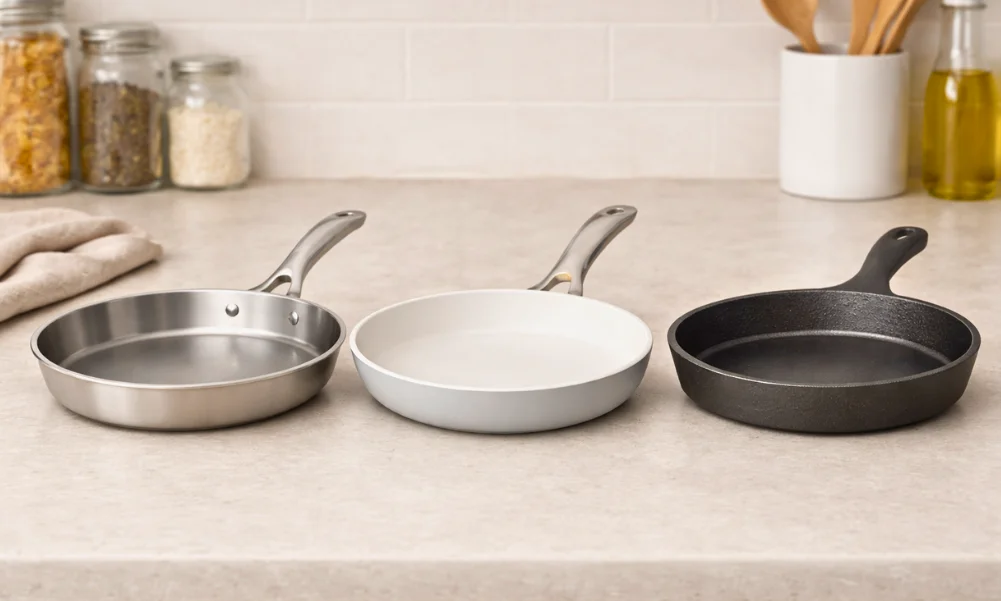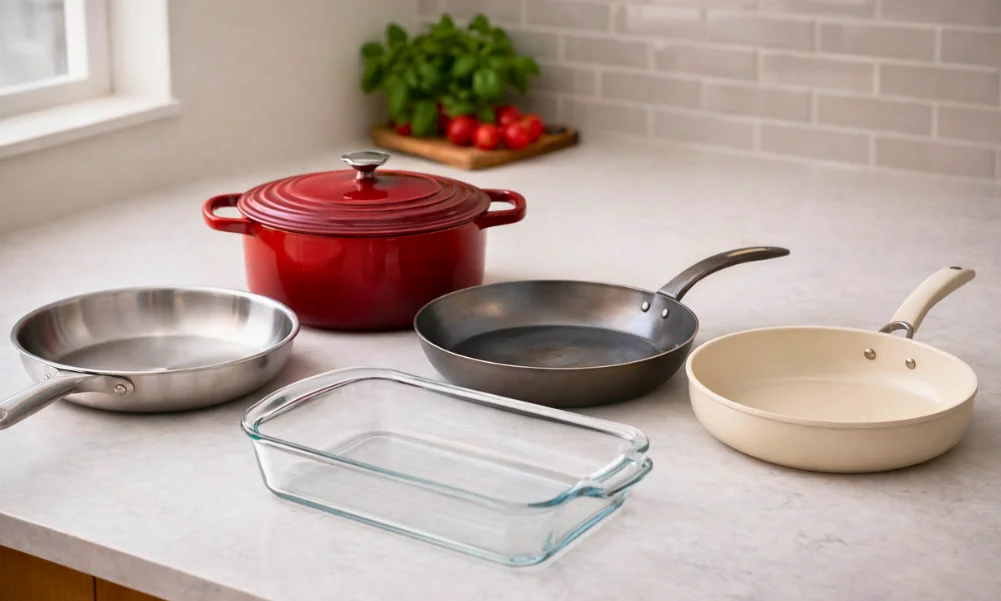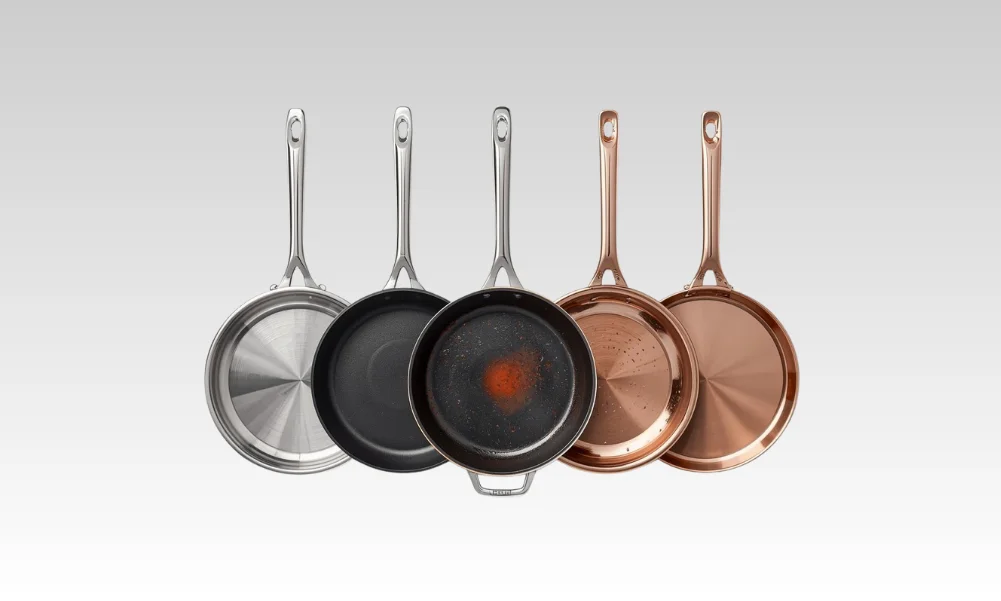
Cookware types describe the materials and construction used to make pots and pans. These choices determine how heat moves, how food behaves during cooking, and how long cookware remains reliable.
Many buyers begin with brand names. In practice, cookware material usually affects cooking performance more than brand reputation alone. Material choice has a greater impact on performance, safety, and longevity than branding.
No single cookware material performs well across all tasks. Each material has strengths that suit certain cooking methods and limitations that affect others.
Understanding cookware types supports more consistent cooking results, reduces unnecessary replacement, and helps align cookware with real kitchen habits rather than assumptions.
This guide explains the most common cookware materials, how they perform, and where their limits become relevant.
If cookware feels confusing or inconsistent, material behavior—not brand choice—is usually the reason.
Quick Answer
Cookware types refer to the materials and construction used to make pots and pans, which directly affect heat movement, food interaction, durability, and maintenance needs.
Different materials behave differently under heat, react differently with foods, and wear at different rates over time.
No single cookware type performs well for every cooking task, which is why material choice matters more than brand name or price.
For most kitchens, stainless steel works best as the primary everyday cookware material, while non-stick, cast iron, or carbon steel handle more specialized tasks.
How Cookware Materials Affect Cooking Results

Cookware materials control heat transfer, heat retention, and surface interaction with food. These characteristics directly influence cooking outcomes.
Some materials conduct heat quickly but lose it just as fast. Others heat more slowly but maintain temperature stability once hot.
Material choice also affects reactions with acidic foods, cookware weight, and long-term maintenance demands.
Thickness and construction influence performance as much as material type. A thin pan behaves differently from a thicker pan made from the same metal, as explained further in Cookware Thickness Explained Why It Affects Heat Control.
Stovetop compatibility also matters. Not all cookware performs safely or efficiently on induction or glass-top surfaces, a limitation explained in What Is Induction Cookware and How Does It Work.
These factors explain why stainless steel supports browning, cast iron favors steady heat, and non-stick performs best at lower temperatures. Material behavior shapes outcomes more than price or appearance.
Key factors influenced by material
- Heat conductivity: How fast heat moves through the pan.
- Heat retention: How well the pan holds heat once hot.
- Reactivity: Whether the material reacts with acidic foods.
- Weight and thickness: Heavier cookware often cooks more evenly but feels harder to handle.
- Maintenance requirements: Some materials need seasoning or careful cleaning.
- Stovetop compatibility: Not all cookware works on induction or glass-top stoves.
These factors explain why:
- Stainless steel excels at searing
- Cast iron works well for slow cooking
- Non-stick performs best at low heat
Choosing cookware becomes easier once these differences are clear.
Common cookware types include:
- Stainless steel cookware
- Cast iron cookware
- Carbon steel cookware
- Non-stick cookware
- Ceramic cookware
- Aluminum cookware
- Copper cookware
- Glass cookware
Best Cookware Material for Different Cooking Styles
Different cookware materials fit different cooking habits. Matching cookware to actual kitchen behavior usually produces better long-term results than buying a single “do everything” cookware set.
| Cooking Style | Recommended Cookware Material |
|---|---|
| Everyday home cooking | Stainless steel |
| High-heat searing | Cast iron |
| Fast stir-frying | Carbon steel |
| Low-maintenance cooking | Non-stick |
| Health-focused cooking | Stainless steel or glass |
| Precise temperature control | Copper |
| Lightweight everyday handling | Aluminum |
| Induction cooking | Magnetic stainless steel or cast iron |
Most balanced kitchens combine multiple cookware materials instead of relying on a single cookware type for every task.
Stainless Steel Cookware
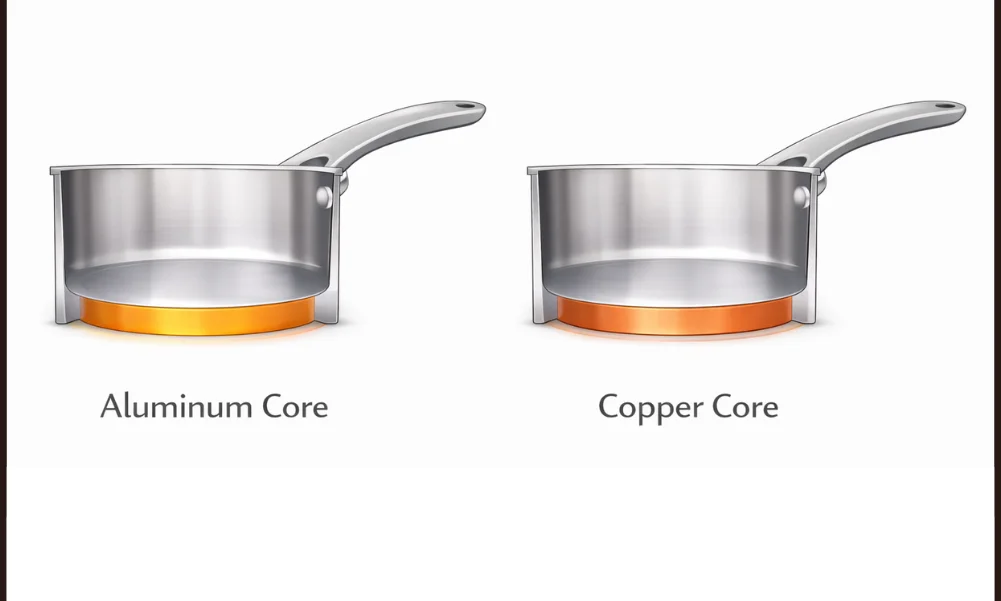
Stainless steel cookware is one of the most widely used materials in home kitchens. Its appeal comes from durability, versatility, and predictable behavior across many cooking tasks.
Most stainless steel cookware is not solid steel. Quality designs use layered construction with an aluminum or copper core to improve heat distribution.
The stainless steel surface remains non-reactive. This makes it suitable for acidic foods and long cooking times without flavor interference.
Stainless steel performs well for searing, browning, sautéing, and sauce preparation. It tolerates medium to high heat and transitions cleanly between stovetop and oven use.
Durability is a primary advantage. Well-constructed stainless steel cookware can remain functional for decades with minimal structural change.
Food sticking is a common concern. Most sticking problems happen when food is added before the pan reaches stable cooking temperature.
This usually reflects heat management and surface temperature rather than material failure.
Lower-quality stainless steel cookware may heat unevenly if core thickness is insufficient. Construction quality matters more than alloy naming or exterior finish, which is explained further in Stainless Steel Cookware Sets.
Stainless steel suits cooks who value control, longevity, and consistent performance across varied cooking methods. Stainless steel’s versatility explains its popularity, but it still performs best when paired with other materials in a balanced kitchen.
Cast Iron Cookware
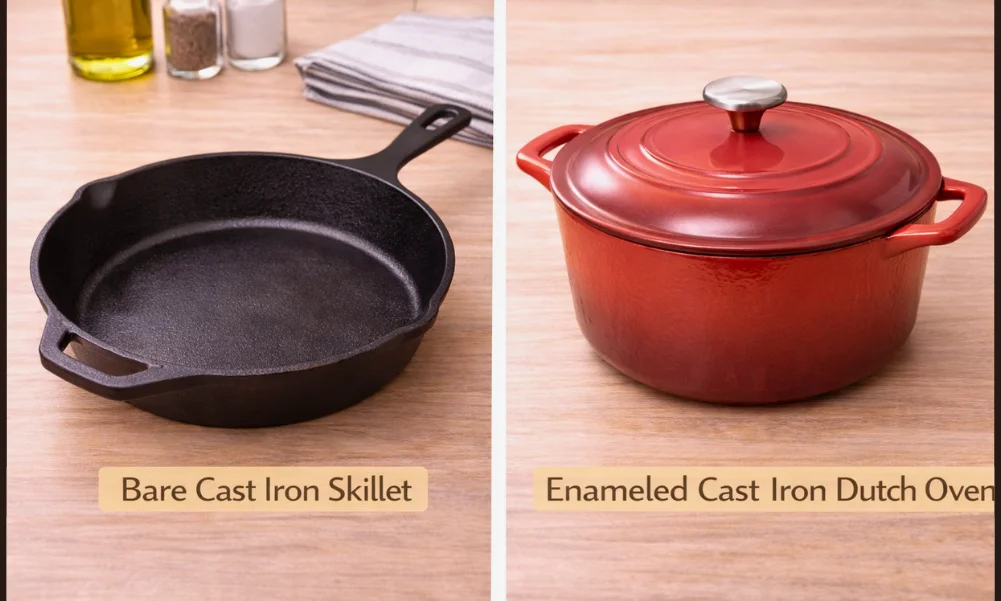
Cast iron cookware is defined by mass and heat retention. It heats slowly but maintains temperature stability once fully warmed.
Cast iron is produced in two primary forms. Bare cast iron relies on seasoning, while enameled cast iron uses a glass-based coating.
Both forms excel at steady, high-temperature applications. These include searing, slow cooking, baking, and extended stovetop use.
Bare cast iron develops a natural non-stick surface through seasoning. This surface improves with use but requires regular maintenance to prevent rust.
Enameled cast iron removes the need for seasoning. The enamel barrier also prevents reaction with acidic foods and simplifies cleaning.
Weight is a limitation. Large cast iron cookware can become difficult to maneuver safely when full, especially during oven transfers.
Cast iron cookware is heavy and responds slowly to temperature changes, which affects precision.
Cracking can occur if cast iron experiences severe thermal shock. This risk is uncommon during normal use but increases with abrupt temperature changes.
Cast iron cookware is valued for longevity. With appropriate care, it can remain functional for generations.
Differences between bare and enameled designs, including durability and maintenance trade-offs, are covered in Enameled Cast Iron Cookware: Pros, Cons, and Care.
Carbon Steel Cookware
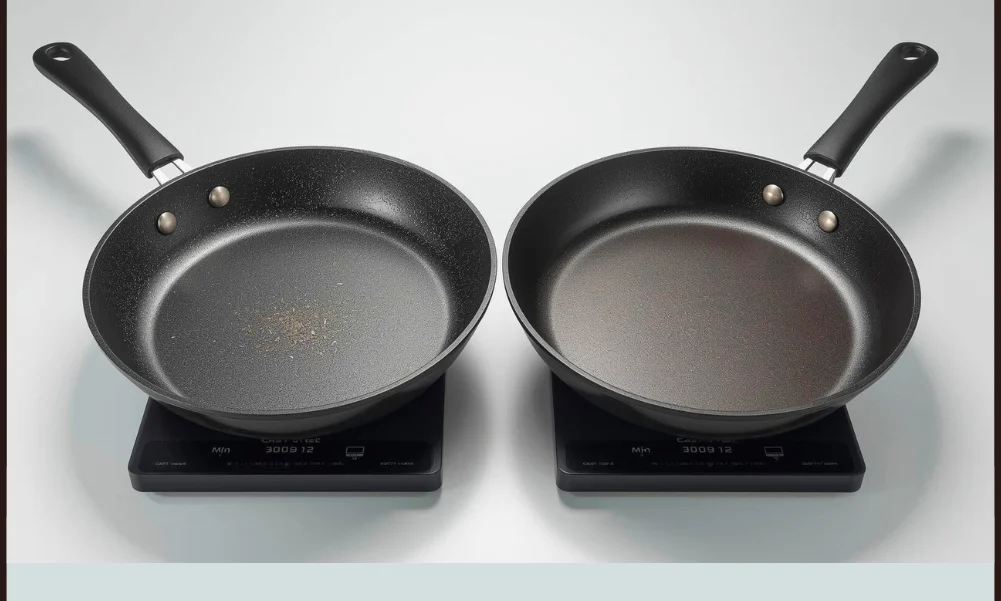
Carbon steel cookware shares similarities with cast iron but behaves differently in daily use. It is thinner, lighter, and more responsive to heat changes.
Carbon steel is made from iron with a small carbon content. Like cast iron, it requires seasoning to create a protective cooking surface.
This material performs well for high-heat cooking. Stir-frying, searing, pan-frying, and wok-style cooking benefit from its fast response.
Carbon steel heats more quickly than cast iron and cools faster when heat is reduced. This responsiveness allows finer control but reduces tolerance for uneven heating.
Seasoning provides corrosion resistance and reduces food sticking. When seasoning is damaged, carbon steel can react with acidic foods and lose performance temporarily.
Warping is the most common limitation. Large or thin carbon steel pans can distort under sudden or excessive heat, as explained further in Cookware Warping Causes, Prevention, and Fixes.
Carbon steel suits cooks who want speed and heat tolerance and are comfortable with maintenance. It rewards consistent technique and gradual heating.
A detailed comparison between carbon steel and cast iron performance is covered in Carbon Steel vs Cast Iron Cookware.
Non-Stick Cookware (PTFE and Ceramic)

Non-stick cookware is designed to reduce surface friction and simplify cooking. Its performance depends on a surface coating rather than the base metal.
There are two primary categories. PTFE-based coatings provide very low friction, while ceramic coatings rely on mineral-based surfaces.
Both types perform best at low to medium heat. They are commonly used for eggs, fish, pancakes, and low-fat cooking.
Ease of use is the main advantage. Food release is predictable, and cleanup requires minimal effort.
Longevity is the main limitation. Even premium non-stick cookware should be viewed as a shorter-lifespan convenience tool rather than permanent cookware.
All non-stick coatings wear over time due to heat exposure, utensil contact, and cleaning.
High heat accelerates surface degradation. Once the coating loses consistency, cooking behavior changes and does not recover.
Safety concerns relate to condition and use rather than age alone. Damaged or peeling coatings should be replaced, a decision explained in When to Replace Non-Stick Cookware.
Modern non-stick cookware remains stable within recommended heat ranges. Is Teflon-Coated Cookware Safe and What Is the Safest Non-Stick Cookware explain the material safety details further.
Non-stick cookware suits convenience-focused cooking with realistic lifespan expectations.
Ceramic Cookware
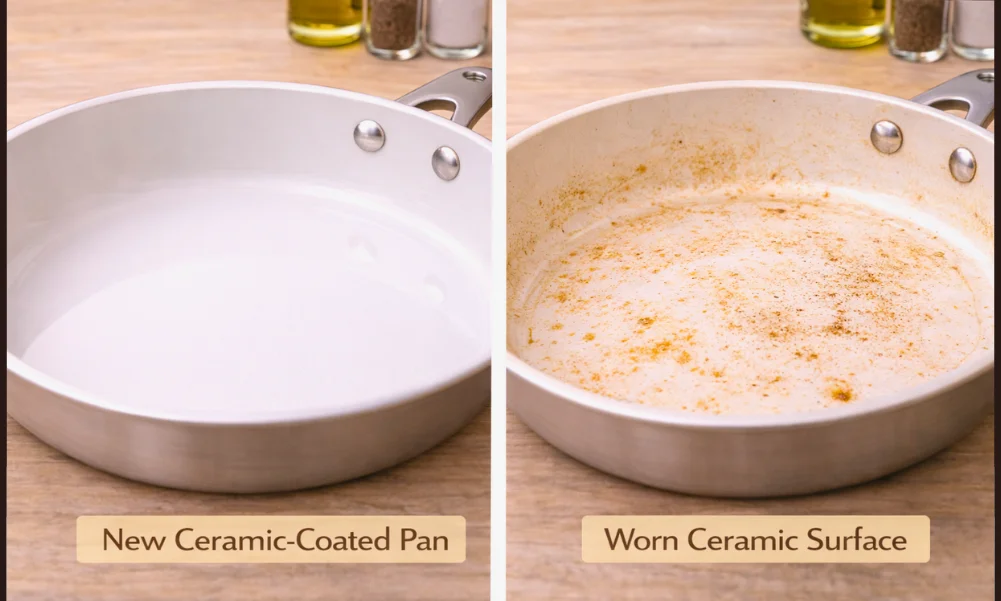
Ceramic cookware is commonly chosen for its non-reactive surface and coating-based food release. Most ceramic cookware sold today uses a ceramic-based coating over a metal core.
Solid ceramic cookware exists but is less common. It behaves differently and is primarily used for baking and oven applications.
Ceramic-coated cookware performs best at low to medium heat. It supports gentle sautéing and everyday meals where moderate temperatures are sufficient.
The surface is smooth when new and does not rely on PTFE. This characteristic appeals to buyers who prefer coatings without fluoropolymers.
Coating durability is the primary limitation. Ceramic coatings wear faster than PTFE coatings and lose release performance gradually.
High heat shortens usable lifespan. Many users mistake coating wear for sudden product failure, even though gradual performance decline is normal with ceramic coatings.
Once food release declines consistently, performance does not return.
Thermal shock can damage solid ceramic cookware. Sudden temperature changes increase cracking risk even when the surface appears intact.
Detailed material behavior and lifespan limits are explained further in Ceramic Cookware Explained.
Ceramic cookware suits low-heat cooking with acceptance of shorter functional lifespan.
Aluminum Cookware
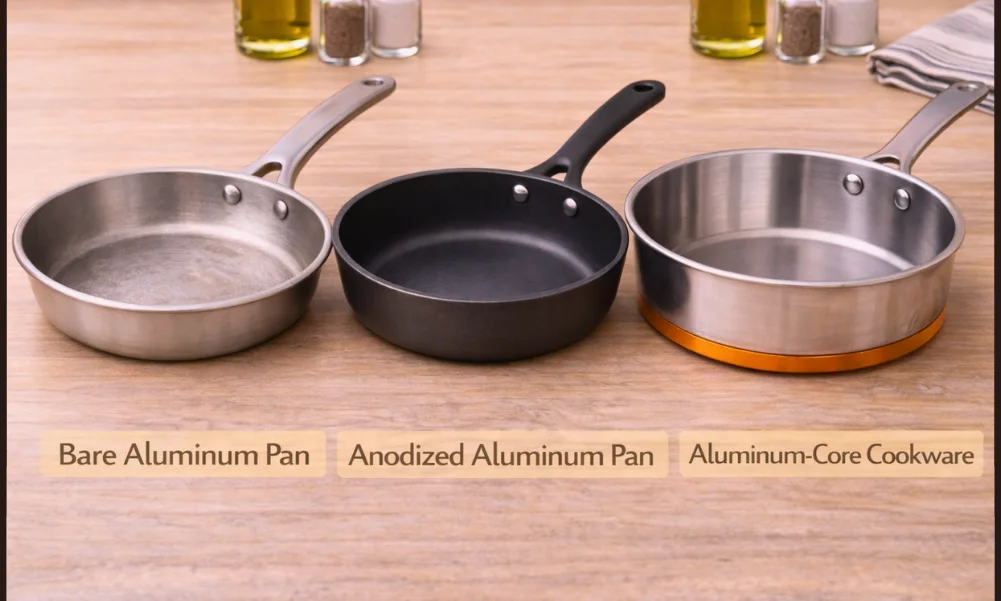
Aluminum cookware is widely used because it conducts heat efficiently and remains lightweight. It responds quickly to burner changes and distributes heat evenly when thickness is adequate.
Aluminum cookware appears in several forms. These include bare aluminum, anodized aluminum, and aluminum used as a core material.
Bare aluminum reacts with acidic foods. This interaction can affect flavor and surface appearance during extended cooking.
Anodized aluminum undergoes surface hardening. This process improves durability and reduces reactivity.
Aluminum cookware performs well for quick cooking tasks and large vessels. Its light weight improves handling, especially for everyday use.
Warping is a common limitation. Thin aluminum cookware is especially vulnerable to warping on powerful induction cooktops.
Thin aluminum bases deform more easily under high heat or rapid temperature change.
Surface damage on anodized aluminum cannot be repaired. Once compromised, performance and protection decline permanently.
Material safety context and usage limits are explained further in Is Aluminum Cookware Safe for Everyday Use.
Aluminum cookware suits users who prioritize responsiveness and lighter handling over extreme durability.
Granite and Stone-Coated Cookware
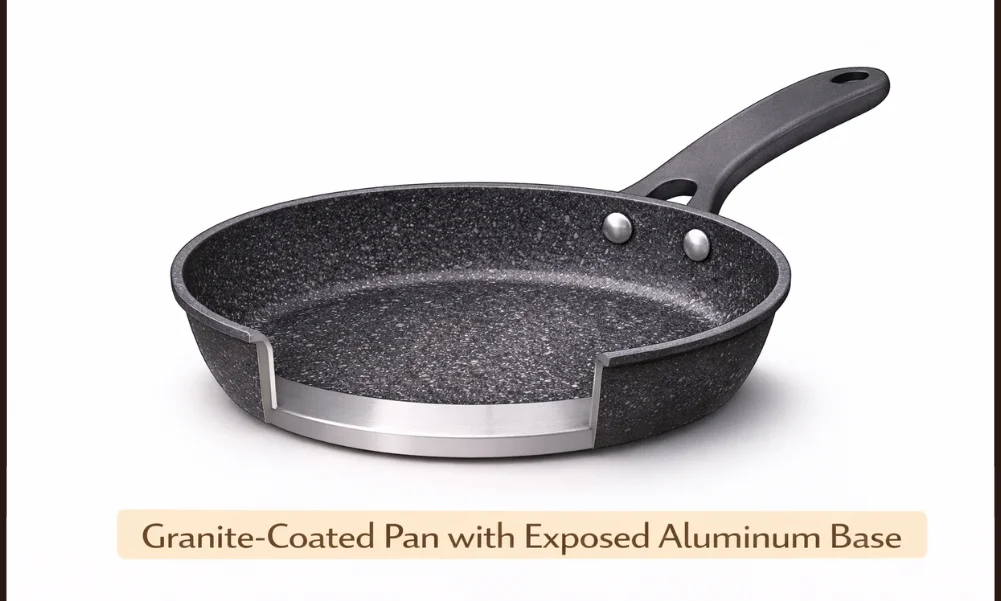
Granite-coated cookware is a category defined by coating style rather than base material. It uses an aluminum body with a mineral-reinforced non-stick coating.
Despite the name, this cookware does not contain solid stone. The coating may include mineral particles to increase surface durability and appearance consistency.
Granite-coated cookware performs best at low to medium heat. It supports everyday meals where easy release and simple cleanup are priorities.
The coating is typically smooth and non-reactive when intact. This makes it suitable for light acidic foods during short cooking periods.
Durability varies widely by construction quality. Thin bases and low-bond coatings wear faster and heat unevenly.
High heat shortens coating lifespan. Once surface consistency declines, food release becomes unreliable.
Marketing terms often obscure construction details. Performance depends on base thickness and coating quality rather than labeling.
Material behavior and limitations are explained further in Granite Cookware Explained.
Granite-coated cookware suits casual cooking with controlled heat expectations. Despite naming differences, performance limits are still defined by coating durability and base construction.
Glass Cookware

Glass cookware is valued for chemical stability and transparency. It does not react with food and does not absorb flavors or odors.
Most modern glass cookware is designed for oven use. Earlier stovetop-safe designs exist but are uncommon today.
Glass cookware performs well for baking, roasting, reheating, and food storage. Visual access during cooking is a practical advantage.
Thermal shock is the primary limitation. Sudden temperature changes can cause cracking or breakage.
Glass retains heat poorly compared to metal cookware. It is not suitable for rapid stovetop temperature control.
Most glass cookware is incompatible with direct induction or flame heating. Usage limits are clarified further in Glass Cookware Heat Safety.
Glass cookware suits oven-focused cooking and users avoiding metal food contact.
Copper Cookware

Copper cookware is defined by rapid heat responsiveness and precise temperature control. It reacts quickly to burner changes and distributes heat evenly across the cooking surface.
Modern copper cookware is almost always lined. Common linings include stainless steel or tin to prevent direct food contact with copper.
Copper excels at temperature-sensitive cooking. Sauces, reductions, and tasks requiring fine heat adjustment benefit most from this material.
Heat control is the primary advantage. Small adjustments translate into immediate surface temperature changes.
Maintenance is a limitation. Copper requires regular polishing to maintain appearance.
Lining condition determines usability. Tin linings wear over time and require re-lining, while stainless steel linings extend lifespan.
Copper cookware is expensive relative to other materials. Cost reflects material price and labor-intensive manufacturing.
Performance and upkeep trade-offs are explained further in Copper Cookware Performance and Maintenance. Copper cookware suits experienced cooks who prioritize precision over convenience.
Titanium-Reinforced Cookware
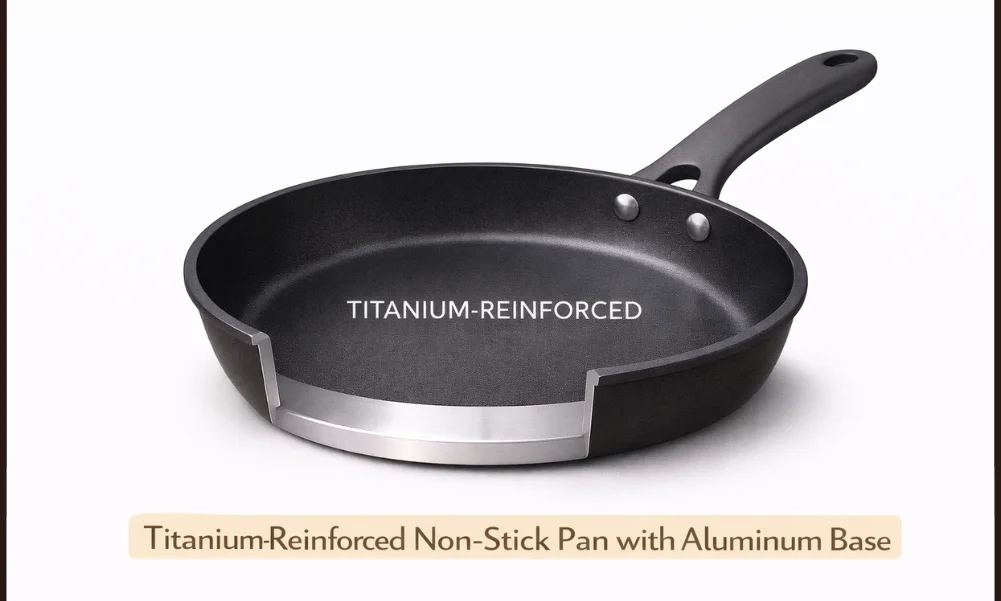
Titanium cookware is often misunderstood. Most consumer products are aluminum cookware with titanium-reinforced non-stick coatings.
Solid titanium cookware is rare in household kitchens. It is primarily used in lightweight outdoor or camping applications.
Titanium-reinforced cookware aims to improve coating durability. Reinforcement increases scratch resistance compared to standard non-stick coatings.
This cookware performs best at low to medium heat. It supports everyday non-stick cooking with easier maintenance.
Coating wear remains the limiting factor. Titanium reinforcement does not eliminate eventual surface degradation.
Marketing claims often exaggerate longevity benefits. Performance still depends on heat control and surface care.
A detailed evaluation of claims and material limits is provided in Titanium Nonstick Cookware Reality.
Titanium-reinforced cookware suits users seeking tougher non-stick surfaces with realistic lifespan expectations.
Waterless Cookware
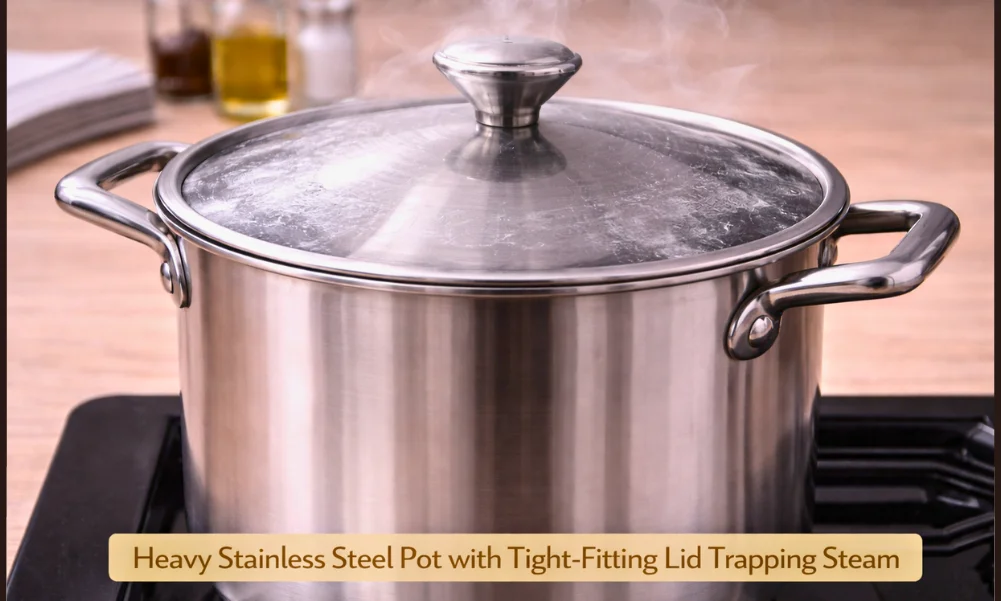
Waterless cookware is designed to cook food using internal moisture rather than added liquid. It relies on heavy construction and tight-fitting lids to limit steam loss during cooking.
Most waterless cookware is made from thick stainless steel or multi-layer metal. The design allows moisture released from food to circulate back into the dish.
This cookware performs best at low to moderate heat. Vegetables, soups, and slow-cooked dishes benefit most from controlled moisture retention.
Performance depends heavily on heat management. Excessive heat can cause sticking or scorching, even with adequate moisture present.
Weight and cost are common limitations. Waterless cookware is heavier than standard cookware and often priced higher.
The technique and design trade-offs are explained in Waterless Cookware Explained.
Waterless cookware suits cooks who prefer controlled, lower-heat cooking and are willing to adjust technique.
Induction Compatibility
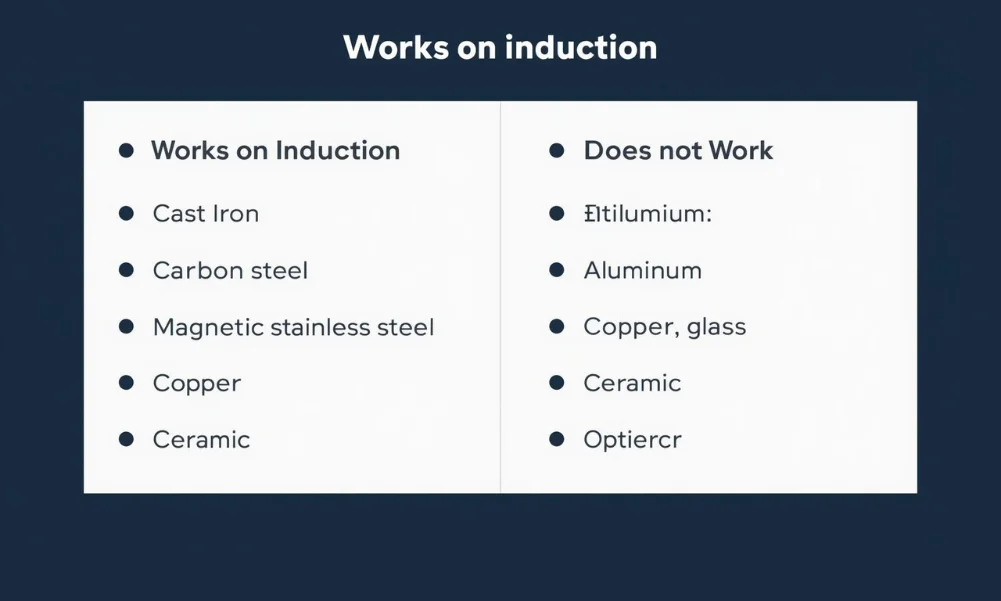
Induction cooking requires cookware made from magnetic materials. Heat is generated within the cookware itself rather than transferred from the cooktop surface.
Cast iron and carbon steel are naturally compatible with induction. Many stainless steel cookware sets also work when the steel is magnetic.
Aluminum, copper, glass, and ceramic cookware usually require a magnetic base layer. Without it, induction cooktops will not recognize the cookware.
Warped or uneven cookware can reduce induction performance. Flat contact with the cooktop is essential for consistent heating.
A detailed explanation of induction behavior and compatibility is covered in What Is Induction Cookware and How Does It Work.
Induction compatibility depends on material composition rather than cookware category labels.
Which Cookware Types Are Safest
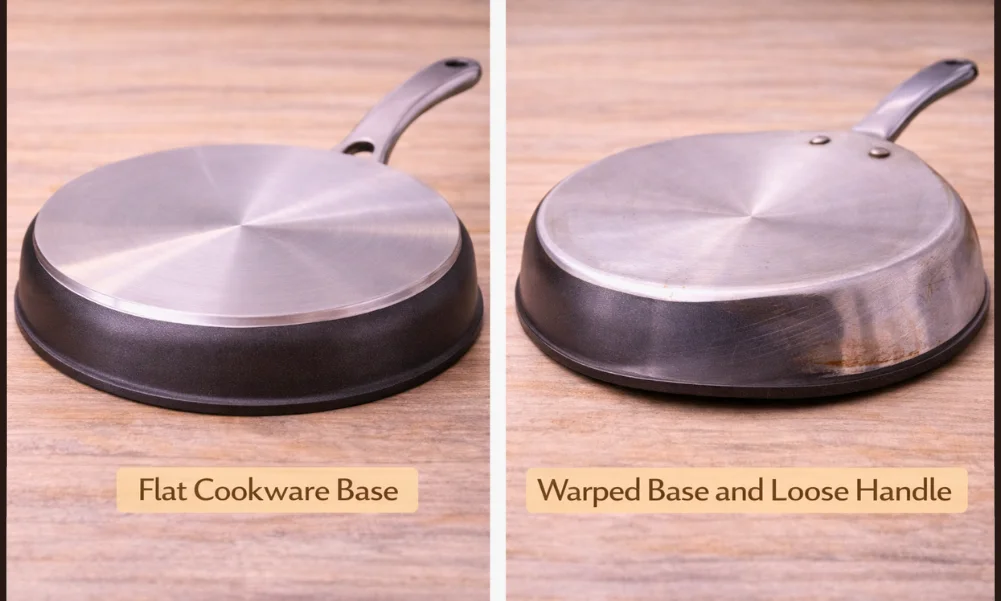
Cookware safety depends on material stability, surface condition, and appropriate use. No cookware material is inherently unsafe when used within its limits.
Non-reactive materials provide the widest margin for everyday cooking. Stainless steel, enameled cast iron, glass, and intact ceramic-coated cookware fall into this group.
Coated cookware remains safe when surfaces are intact and heat is controlled. Safety concerns increase when coatings peel, flake, or overheat.
Structural stability matters more than appearance. Loose handles, warping, and surface separation indicate declining safety.
Clear warning signs and replacement thresholds are outlined in Signs Your Cookware Is No Longer Safe to Use.
Safety outcomes are driven by condition and behavior rather than material alone.
Longevity Differences Between Cookware Materials
Cookware lifespan varies by material and construction quality. Some materials are designed for long-term use, while others are consumable by nature.
Non-stick cookware has a limited functional lifespan due to coating wear. Replacement is expected once food release and surface consistency decline.
Uncoated metals such as stainless steel, cast iron, and carbon steel can last decades. Longevity depends on heat management and structural integrity.
Coated cookware lifespan shortens under high heat and abrasive cleaning. Thickness and core construction influence resistance to warping.
Realistic lifespan expectations by material are explained in How Long Should Cookware Last.
Longevity improves when cookware is matched to appropriate tasks rather than forced into universal use.
Choosing Cookware Based on Cooking Habits
Cookware selection works best when guided by cooking habits rather than trends. Different materials support different cooking priorities.
Daily home cooking benefits from stainless steel and durable coated cookware. These materials balance control, durability, and ease of maintenance.
High-heat cooking favors cast iron, carbon steel, and quality stainless steel. These materials tolerate sustained heat without surface breakdown.
Low-maintenance cooking suits non-stick and ceramic-coated cookware. Shorter lifespan is offset by convenience and ease of cleanup.
Health-focused cooking often prioritizes non-reactive materials. Stainless steel, enameled cast iron, and glass meet this preference.
Balanced kitchens distribute tasks across materials to reduce wear concentration.
Which Cookware Materials Last the Longest
Cookware lifespan depends on both material stability and construction quality.
Stainless steel, cast iron, and carbon steel cookware can remain functional for decades because they do not rely on coatings that wear away over time.
Non-stick and ceramic-coated cookware have shorter functional lifespans because cooking performance depends on surface coatings that gradually degrade with heat exposure and regular use.
Enameled cookware typically lasts longer than coated non-stick cookware, but enamel can chip or crack if cookware experiences impact or thermal shock.
Longevity usually improves when cookware is matched to appropriate cooking tasks rather than forced into every cooking situation.
Common Cookware Buying Mistakes
Many cookware frustrations come from mismatched expectations rather than defective cookware.
Common buying mistakes include:
- Buying large cookware sets without considering actual cooking habits
- Overheating non-stick cookware regularly
- Choosing heavy cookware without considering handling comfort
- Assuming expensive cookware automatically improves cooking results
- Ignoring induction compatibility before purchase
- Using thin cookware on powerful burners
- Expecting one cookware material to perform equally well for every cooking task
Understanding these tradeoffs usually leads to better long-term cookware satisfaction.
Common Cookware Myths
Many cookware decisions are shaped by persistent misconceptions. These myths often lead to mismatched purchases.
Higher price does not guarantee better performance. Material choice and construction quality matter more than branding.
No single cookware set handles every task equally well. Different materials excel under different conditions.
Non-stick cookware is not inherently unsafe. Problems arise from overheating or continued use after surface failure.
Heavier cookware is not always better. Weight improves heat retention but can reduce handling comfort. Understanding these limits improves long-term satisfaction.
Signs You Bought the Wrong Cookware Type
Cookware mismatch often becomes noticeable through daily cooking frustration rather than obvious damage.
Common warning signs include:
- Food burns unevenly despite normal heat settings
- The cookware feels too heavy to use comfortably
- Non-stick coatings lose release performance quickly
- Stainless steel sticking becomes frustrating during daily cooking
- Carbon steel or cast iron maintenance feels unrealistic for your routine
- Cookware repeatedly warps under normal cooking temperatures
- Cleanup difficulty changes how often certain cookware gets used
The best cookware type is usually the one that fits real cooking habits consistently, not the one with the most marketing claims.
Which Cookware Type Is Best
- Best overall for most kitchens: Stainless steel
- Best for high-heat cooking: Cast iron
- Best for easy cleanup: Non-stick
- Best for fast heat response: Copper
- Best for lightweight handling: Aluminum
- Best for induction cooking: Magnetic stainless steel or cast iron
- Best for stir-frying: Carbon steel
No cookware material performs best in every situation, which is why many kitchens combine multiple cookware types.
Cookware Types Summary Table
This comparison highlights functional tradeoffs, not “best” materials.
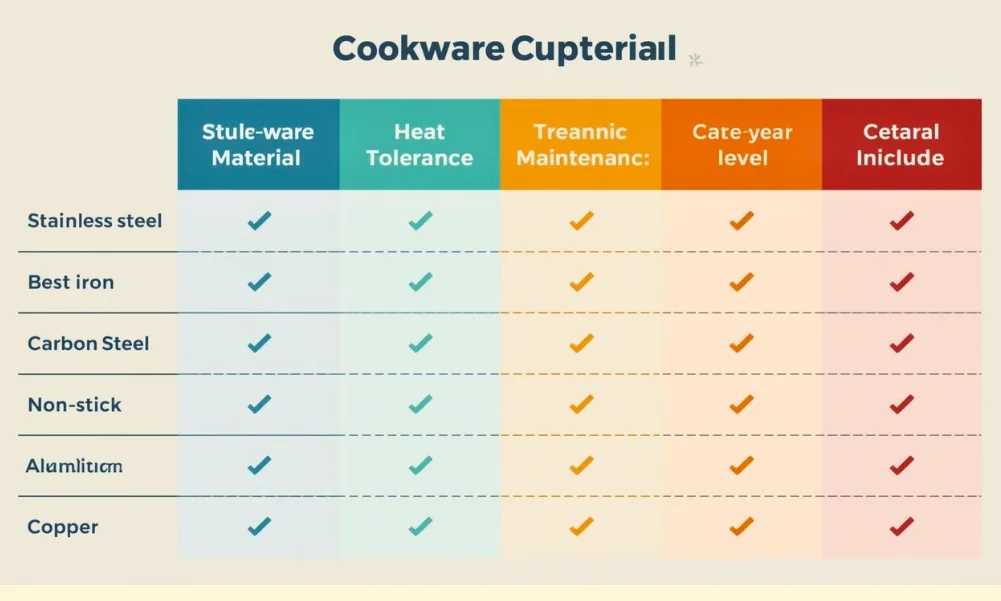
This table provides a quick comparison of common cookware materials.
| Material | Best For | Key Limitation | Maintenance Level |
|---|---|---|---|
| Stainless Steel | Daily cooking, searing | Food sticking | Low |
| Cast Iron | High heat, slow cooking | Heavy, slow response | Medium |
| Carbon Steel | High-heat, fast cooking | Needs seasoning | Medium |
| Non-Stick | Eggs, low-heat cooking | Short lifespan | Low |
| Ceramic | Health-focused, light meals | Coating wear | Low |
| Copper | Precise temperature control | Cost, maintenance | High |
| Aluminum | Lightweight, even heating | Reactivity if uncoated | Low |
| Granite-Coated | Easy everyday cooking | Coating durability | Low |
| Glass | Baking, storage | Thermal shock risk | Low |
| Waterless | Slow cooking | Learning curve | Medium |
This overview helps compare options quickly.
Frequently Asked Questions
What cookware material lasts the longest?
Stainless steel, cast iron, and carbon steel cookware usually last the longest because they do not rely on surface coatings that wear away over time.
What is the safest cookware material?
Stainless steel, glass, and enameled cast iron are widely considered among the safest cookware materials because they remain stable during normal cooking temperatures.
Which cookware works best on induction cooktops?
Magnetic cookware materials such as cast iron and induction-compatible stainless steel work best on induction stoves.
Why does food stick to stainless steel pans?
Food usually sticks when the pan is not fully preheated or when cooking temperature changes too quickly during cooking.
Is ceramic cookware safer than non-stick cookware?
Ceramic cookware avoids PTFE coatings, but both ceramic-coated and modern PTFE cookware are generally considered safe when used within recommended heat ranges.
Why do cookware pans warp?
Warping usually happens because of excessive heat, sudden temperature changes, or thin cookware construction.
Final Takeaway
Cookware types are defined by material behavior, not marketing labels. Each material offers strengths alongside clear limitations.
Cooking results, safety, and longevity improve when materials match actual use. No cookware performs optimally across every task.
Informed selection reduces unnecessary replacements and frustration. The best cookware material is usually the one that fits your cooking habits, maintenance tolerance, heat preferences, and kitchen setup.
For deeper evaluation, related guides include High-Quality Cookware Brands, Cookware Thickness and Heat Control, and Cookware Safety Certifications Explained.
This foundation supports confident, long-term cookware decisions based on behavior rather than assumptions.
What to Read Next
This guide explains how cookware materials behave in real kitchens. If you want to go deeper into specific decisions, the following resources build on this foundation.