Quick Answer
There is no universal “best” cookware. Performance depends on use, heat, handling, and maintenance realities. Our selection process focuses on predictable behavior under real kitchen conditions, with limits documented as carefully as strengths.
Our Cookware Evaluation Criteria (Summary)
KitchenMarks evaluates cookware based on six core factors:
| Criteria | What We Look For |
|---|---|
| Heat Behavior | Predictable heating and cooling |
| Real-World Use | Performance after repeated daily cooking |
| Material Limits | How materials degrade over time |
| Handling | Balance and safety when moving cookware |
| Cleaning & Maintenance | Durability under normal cleaning |
| Storage Stress | Resistance to stacking and cabinet wear |
Each factor reflects how cookware behaves in real kitchens rather than controlled laboratory environments.
Who This Is For
This article is for readers who want to understand how KitchenMarks evaluates cookware before trusting any recommendation. It applies to buyers comparing multiple “best” guides, skeptics of affiliate content, and cooks who have been disappointed by cookware that looked good on paper but failed in use.
It is not written to sell cookware. It exists to explain how decisions are made and where they stop.
What This Article Does
This guide explains:
- The criteria we use to evaluate cookware
- The tradeoffs we consider unavoidable
- The limits of what our recommendations can promise
It is designed to give context to every “Best” article on KitchenMarks, not to replace them.
What This Article Does Not Do
This article does not claim laboratory-grade testing, universal rankings, or cookware that works for every kitchen. We do not present controlled lab metrics or manufacturer-sponsored results. Our goal is clarity, not spectacle.
Why “Best” Cookware Is Contextual
Cookware does not fail randomly. It fails when used outside its comfort zone. Heat tolerance, surface treatment, weight, and storage stress determine whether a pan performs quietly for years or degrades early.
Most negative cookware reviews trace back to mismatch rather than defect. High-heat cooking in coated pans, acidic simmering in reactive materials, or repeated overheating of empty cookware explain the majority of complaints.
See: cookware types explained and choose cookware by-cooking style.
Because of this, we do not rank cookware across unrelated categories. A skillet optimized for searing is not “better” than one optimized for low-maintenance cooking. Each succeeds within defined boundaries.
Our Core Cookware Evaluation Criteria
Our methodology treats cookware as a system of tradeoffs. Strengths are only meaningful when limits are acknowledged. A recommendation without boundaries is incomplete—and often misleading.
1. Heat Behavior & Control

Heat behavior is the single most important performance factor we evaluate. It determines how cookware responds to burners, how forgiving it is under stress, and how easily it can be misused.
We observe two primary traits:
- Heat retention: how much heat the cookware stores once hot
Cookware that retains heat well performs reliably for searing, frying, and oven use, but it can overshoot temperatures if handled aggressively. Highly responsive cookware allows fine control but loses heat quickly and can struggle with stability.
Most long-term failures come from ignoring this balance. Empty cookware overheated on high burners, coated cookware pushed past its heat limits, and thin cookware exposed to uneven burners account for a large share of negative outcomes.
See: cookware thickness heat control, maximum safe-heatcookware-materials, and /heating-empty-cookware-risk)
We do not reward extreme heat tolerance or extreme responsiveness in isolation. We prioritize cookware that behaves predictably within its intended range and communicates its limits clearly through use.
2. Real-World Use Patterns
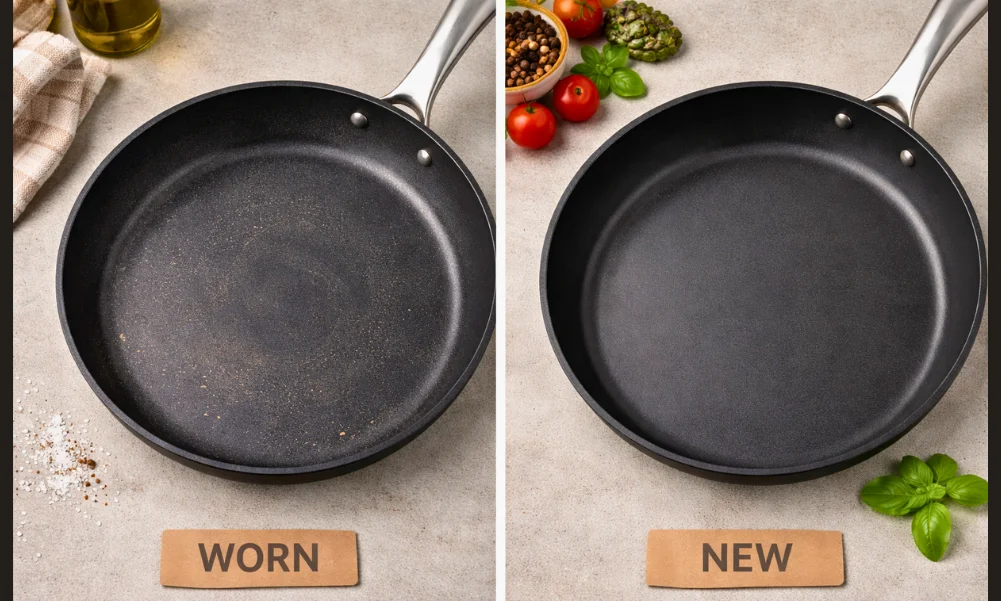
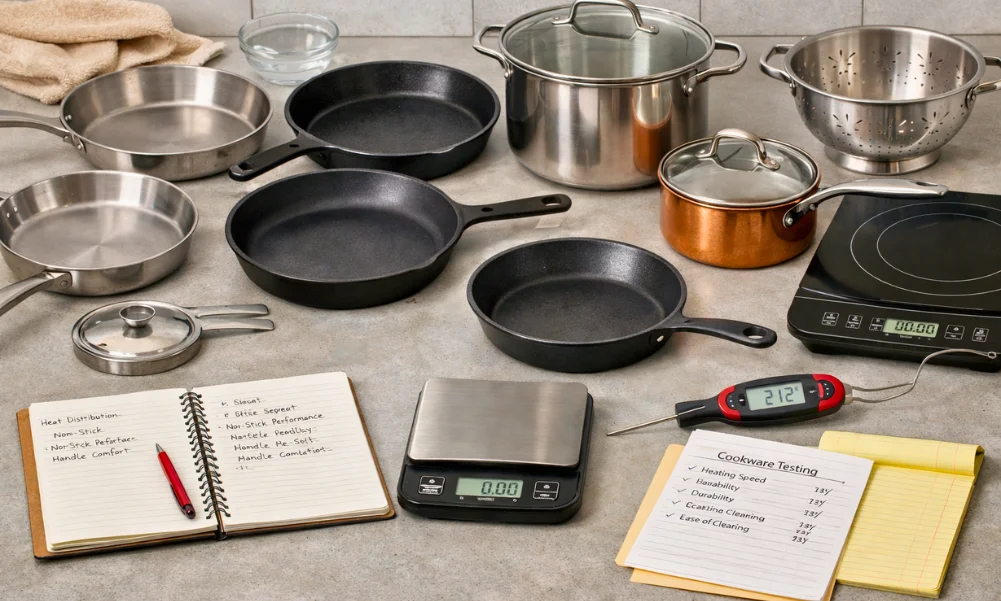
Cookware is not evaluated in isolation or ideal conditions. We consider how it performs under repetition, time pressure, and uneven attention—because that is how most kitchens operate.
Key observations include:
- How cookware behaves after repeated weekday use
- Whether performance changes noticeably with normal wear
- If small mistakes accumulate into meaningful degradation
Cookware that performs well once but degrades quickly under routine use is not scored highly. Likewise, cookware that requires careful, infrequent use to maintain performance is flagged for limited suitability.
Longevity is judged by consistency, not perfection. Pieces that continue to behave the same way after months of regular use are more valuable than those that deliver peak performance briefly and then decline.
See: how long should cookware last.
We assume normal use, not ideal use. That assumption drives most inclusion and exclusion decisions across our “Best” articles.
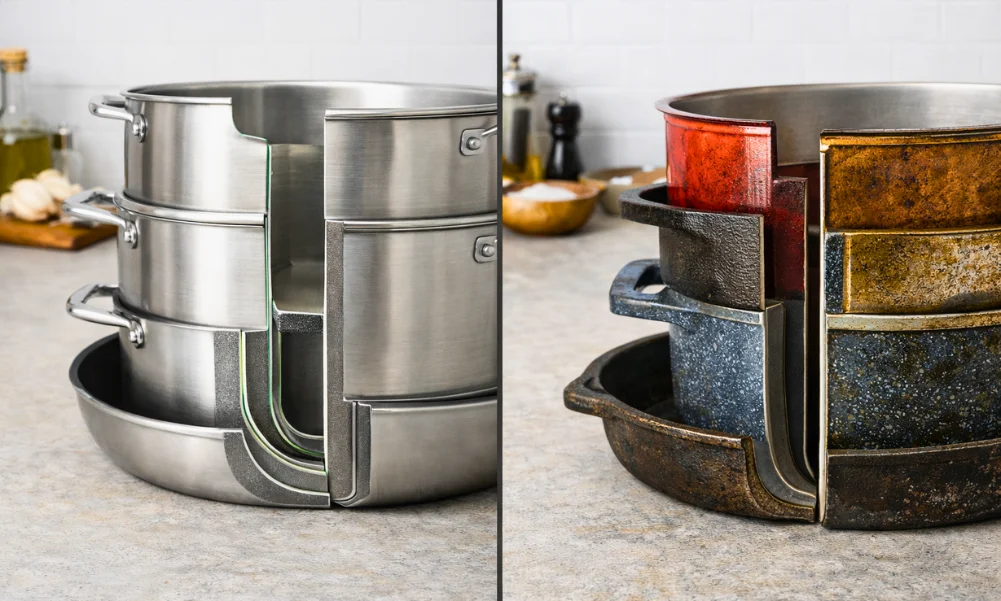
3. Material Limits & Tradeoffs
No cookware material is failure-proof. Every material carries limits that matter more than headline benefits. Our evaluations document those limits explicitly rather than treating them as edge cases.
We assess materials based on:
- How they respond to prolonged heat exposure
- Whether surfaces degrade gradually or abruptly
- How they behave with acidic ingredients and repeated cleaning
Coatings are evaluated for durability under normal use, not abuse. Reactive materials are evaluated for how quickly performance changes when used outside their ideal context. Materials that fail suddenly or without clear warning receive lower confidence ratings than those that degrade slowly and predictably.
See: acidic foods cookware materials, ceramic vs granite cookware, and stainless steel vs non stick cookware.
Tradeoffs are treated as design choices, not defects. A material optimized for easy cleanup may sacrifice heat tolerance. A material built for extreme heat may demand more maintenance.
We document these relationships so readers understand what they are accepting in exchange for performance.
Some material limitations have also become more visible due to recent PFAS-related changes in cookware manufacturing.
4. Handling, Weight & Ergonomics
Most cookware injuries and accidents happen during movement, not cooking. Lifting a full pan, pouring hot contents, or transferring cookware between surfaces introduces more risk than heat alone.
Our handling evaluation considers:
- Weight when cookware is filled, not empty
- Handle security and balance
- Ease of controlled pouring and repositioning
Cookware that feels manageable empty but becomes unstable when full is flagged. We also consider how ergonomics change with fatigue, because performance late in a cooking session matters as much as performance at the start.
See: cookware thickness heat control and riveted vs welded cookware handles.
We do not assume ideal strength, grip, or counter space. Predictable handling under realistic conditions is weighted more heavily than maximum capacity or visual appeal.
5. Cleaning, Maintenance & Aging
Cookware performance is inseparable from how it ages. We evaluate not just how cookware cleans when new, but how cleaning affects it over time. Over-cleaning causes as much damage as neglect, especially with coatings and seasoned surfaces.
Our assessment looks at:
- How easily food residue releases under normal cleaning
- Whether aggressive cleaning accelerates wear
- How surfaces change after repeated cycles of use and cleaning
Cookware that demands constant intervention to maintain baseline performance is flagged. We favor materials and finishes that tolerate routine cleaning without rapid degradation.
See: damage cookware by over cleaning, cookware discoloration causes cleaning, and repair scratched cookware.
Aging is evaluated for predictability. Gradual, visible wear that does not affect safety or basic performance is treated differently from sudden failure. Cosmetic changes alone do not disqualify cookware.
6. Storage Stress & Longevity
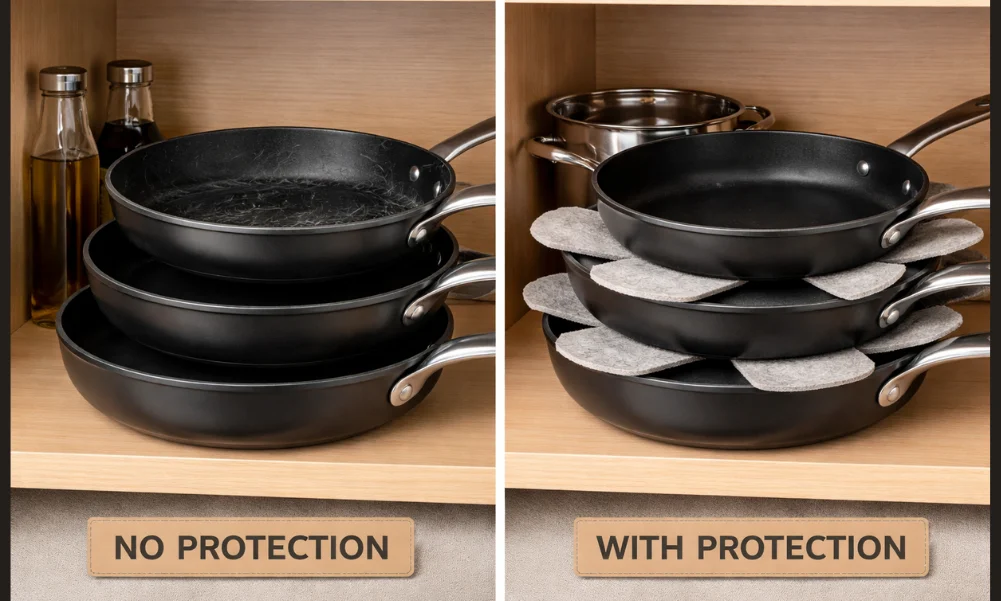
Storage stress is one of the least discussed but most common causes of cookware damage. Stacking pressure, lid contact, and cramped cabinets degrade cookware even when it is rarely used.
We evaluate:
- How cookware stacks with similar pieces
- Whether rims, coatings, or bases are vulnerable during storage
- How lid storage affects long-term wear
Cookware that requires special storage solutions to avoid damage is noted as such. We do not assume unlimited space or custom storage infrastructure.
See: cookware storage ideas protect pots pans and cookware lid storage space saving.
Longevity is assessed as a system outcome. Cookware that survives cooking but fails in storage is not considered durable in real kitchens.
What We Don’t Test
Clear limits are part of credibility. Our evaluations are designed to reflect real kitchens, not laboratory extremes.
We do not:
- Perform destructive testing or intentionally damage cookware
- Rely on manufacturer-paid laboratories or unpublished test data
- Attempt to rank cookware across unrelated categories
- Claim that one piece replaces every other pan
We also do not test cookware outside reasonable household use. Abuse scenarios can be informative, but they rarely predict real ownership outcomes.
See: cookware safety certifications explained.
When information falls outside these boundaries, we say so. Silence is preferable to false precision.
How Products Are Selected for “Best” Articles
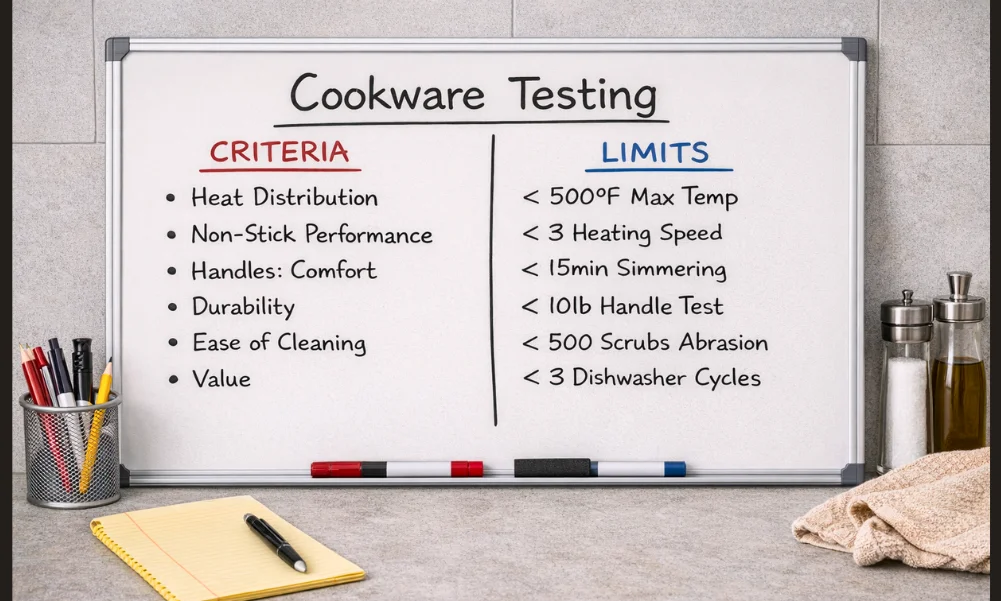
Before any product appears in a “Best” guide, it must pass baseline eligibility checks. These filters exist to reduce redundancy and prevent marketing-driven inclusion.
Eligibility Filters
- The model has a stable, long-standing design
- It serves a clear, non-overlapping role
- Its material limits are well-documented
- Safety behavior is predictable under normal use
Why Some Products Are Excluded
Products are excluded when they:
- Duplicate an existing role without meaningful improvement
- Rely on vague or fear-based safety claims
- Introduce conflicting care rules within a system
- Prioritize aesthetics over functional clarity
We do not assume newer is better. We also do not assume popularity equals performance.
See: cookware set vs individual pieces and high quality cookware brands.
Safety & Trust Perspective
Safety language requires restraint. Most cookware issues are not emergencies. They are performance degradations caused by heat misuse, improper cleaning, or storage stress.
Our approach emphasizes:
- Predictable behavior over absolute claims
- Clear misuse boundaries
- Distinguishing cosmetic damage from functional risk
We avoid medical or toxic claims unless supported by clear, widely accepted standards. When cookware is no longer safe to use, we state why. When it is merely worn, we explain the difference.
See: signs cookware not safe to use and cookware safety certifications explained.
Trust is built by documenting limits, not by overstating protection.
How to Use Our Recommendations
“Best for” means best within a defined context. Each recommendation assumes specific cooking styles, storage realities, and maintenance tolerance.
You should ignore our picks when:
- Your cooking style does not match the use case
- Weight or storage constraints make handling unsafe
- Maintenance requirements conflict with your routine
Our guides are decision tools, not prescriptions. The right cookware is the one that fits your habits quietly and consistently.
See: choose cookware by cooking style.
Where Our “Best Cookware” Guides Fit
The evaluation framework described in this article informs every cookware recommendation on KitchenMarks.
Rather than ranking cookware universally, our “Best” guides group cookware by cooking needs, materials, and kitchen setups.
Examples include:
• Best Cookware Sets for Home Kitchens
• Best Ceramic Cookware for Healthy Cooking
• Best Cookware for Induction Cooktops
• Best Cookware for Everyday Home Cooking
Each guide applies the same criteria described here while recognizing that cookware succeeds within specific use cases rather than across all kitchens.
Closing Summary
Cookware selection is an exercise in tradeoffs. Our testing criteria prioritize predictable behavior, real-world use, and long-term ownership realities. Limits are treated as essential information, not fine print.
“Best” cookware works when expectations are realistic. Understanding how and why we evaluate cookware helps you decide when to follow our recommendations—and when to ignore them.