

Quick Answer
Induction cookware is cookware with a magnetic base that can interact with the electromagnetic field of an induction cooktop. The cooktop does not heat the glass first; it creates energy that the pan converts into heat.
If a magnet sticks firmly to the bottom of your pan, it will usually work on induction. However, the magnet test only confirms compatibility. It does not guarantee even heating, durability, warp resistance, or overall cooking quality.
Do You Need Special Induction Cookware?
Not always. Many pans people already own can work on induction if the base contains magnetic material.
Cast iron, carbon steel, and many stainless steel pans are naturally induction-compatible. Aluminum, copper, glass, and ceramic cookware usually need a magnetic base layer or will not work.
The important point is this: induction cookware is not automatically a special premium category. It simply means the cookware has the right magnetic structure for an induction cooktop.
Before buying a full new cookware set, test your current pans first. If you are unsure which pieces are worth replacing first, it helps to choose cookware by cooking style rather than buying a full set immediately. You may only need to replace one or two pieces.
What “Induction Cookware” Actually Means
The term “induction cookware” can sound like a separate class of cookware. In practice, it simply means cookware that contains magnetic material in the base.
An induction cooktop creates an electromagnetic field below the glass surface. When a pan with ferrous, magnetic material sits on the cooktop, that magnetic field creates heat inside the pan base. The cooktop transfers energy; the pan becomes the heat source.
This is why some metal cookware works on induction while other metal cookware does not. Aluminum and copper conduct heat well, but they are not magnetic by themselves. Stainless steel varies by alloy and construction. Cast iron and carbon steel are naturally magnetic.
For a broader breakdown of how different cookware materials behave, see our guide to cookware materials.
A useful way to understand induction compatibility is like a key and lock. The cooktop provides the energy, but the pan must have the right magnetic base to receive it. Without that match, the burner may not detect the pan or produce heat.
This also explains why induction compatibility does not equal quality. A pan can be induction-compatible but poorly made. Another pan can be excellent on gas or electric but incompatible with induction because of its material.
Quick Compatibility Check Before Buying Anything
Use this simple checklist before replacing cookware:
| Check | What to Do | Why It Matters |
|---|---|---|
| Magnet test | Place a magnet on the bottom of the pan | If it sticks firmly, the pan will usually work |
| Flat base | Set the pan on a flat surface | Warped pans heat unevenly and may not sit safely |
| Base size | Compare the pan base with the induction burner size | Very small bases may not activate some burners |
| Stable contact | Make sure the pan does not wobble | Better contact improves heating and safety |
| Induction symbol | Look for the coil-style induction mark | Helpful, but not required if the magnet test passes |
A strong magnet pull is the fastest sign of compatibility. A weak magnet pull may still work on some cooktops, but performance can be inconsistent.
Base thickness also matters because induction sends energy into the pan quickly; our guide to cookware thickness and heat control explains why thin and thick pans behave differently.
Compatibility Does Not Equal Performance
A pan can be induction-compatible and still perform poorly.
The magnet test tells you whether the pan can activate an induction burner. It does not tell you whether the pan will heat evenly, resist warping, hold up over time, or cook well.
For a deeper explanation of why some pans heat evenly while others create hot spots, read our guide on how heat distribution works in cookware.
For better induction performance, look for:
- a flat bottom
- a strong magnetic base
- enough base thickness
- good bonding between layers
- a pan base that matches the burner size
- stable contact with the glass surface
This is why two pans can both be labeled “induction-compatible” but behave very differently in daily cooking.
How Induction Cooking Works
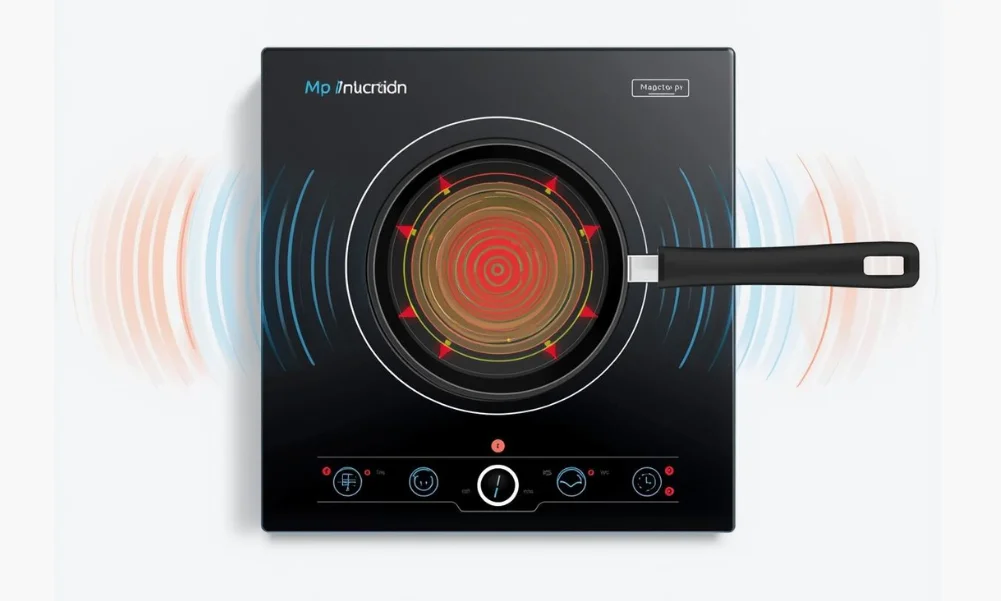
Induction cooking works by transferring energy directly into compatible cookware through magnetism.
Inside the cooktop, a coil creates an electromagnetic field. When magnetic cookware sits on the surface, that field interacts with the pan base and produces heat inside the cookware itself.
The basic process is:
- The induction coil creates a magnetic field.
- The magnetic field reaches the cookware base.
- The magnetic material in the pan responds to the field.
- Heat is generated directly in the pan.
- The food cooks because the pan heats up, not because the glass surface is the main heat source.
This is why induction cooktops often feel faster and more responsive than gas or traditional electric cooktops. The energy does not need to heat a burner first and then pass slowly into the pan. It acts directly on the cookware.
The glass surface can still become hot from contact with the pan, but it is not the original heat source.
Why Induction Feels Faster and More Responsive
Induction feels fast because heat is created directly in the cookware. When you increase the power, the pan responds quickly. When you lower the power, the energy flow drops almost immediately.
This responsiveness is useful for boiling, searing, simmering, and quick temperature adjustments. However, it also means mistakes show up faster.
For example, an empty thin pan can overheat quickly on a high setting. This is why empty preheating deserves caution; our guide to heating empty cookware risk explains when preheating becomes damaging.
A delicate sauce may need lower power than expected. A pan that worked acceptably on gas may reveal hot spots on induction because the energy is more concentrated and immediate.
Induction gives more control, but it also rewards better cookware construction and more careful heat management.
What Makes Cookware Induction-Compatible?
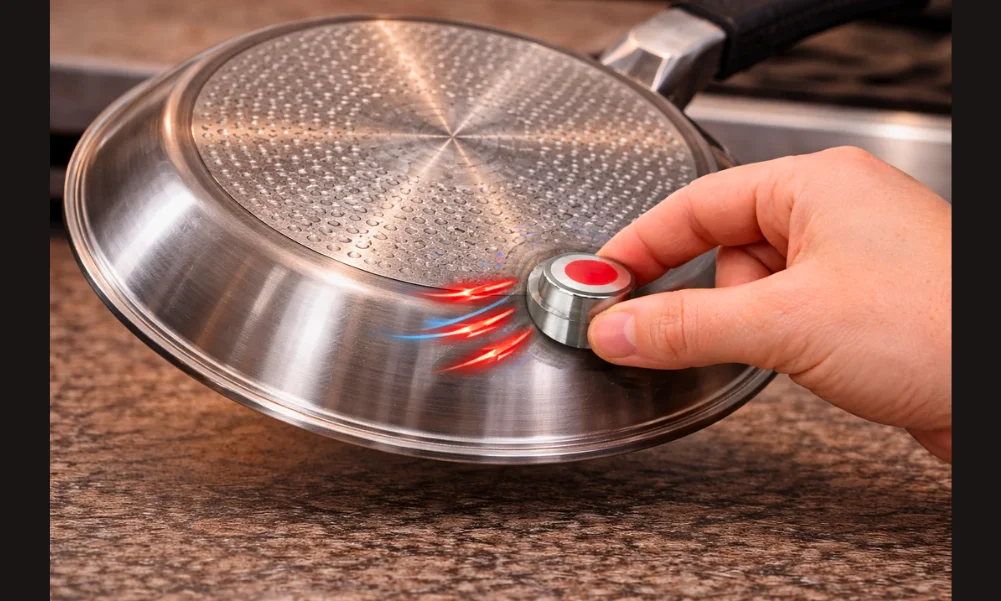
Induction compatibility depends mainly on the cookware’s base. The pan must contain magnetic material that can respond to the cooktop’s electromagnetic field.
1. Magnetic Material
The base must contain ferrous material. Cast iron and carbon steel meet this requirement naturally. Many stainless steel pans also work, but not all stainless steel is magnetic.
Aluminum and copper do not work on induction by themselves. They need a magnetic layer bonded to the base.
2. Flat Bottom
A flat bottom helps the cookware sit securely on the glass surface. Warped or uneven cookware may heat poorly, wobble, or fail to make proper contact.
3. Proper Base Size
Some induction cooktops require a minimum pan diameter. If the magnetic part of the base is too small, the cooktop may not detect the pan.
4. Strong Base Construction
A good induction pan should have a base that spreads heat beyond a small center point. Thin or poorly bonded bases can create hot spots, uneven cooking, and long-term warping.
5. Cooktop Detection
Induction cooktops use sensors to detect compatible cookware. If the pan is non-magnetic, too small, off-center, or warped, the burner may not turn on.
Magnetic Base Requirement
For induction to work, cookware must contain magnetic material in the base. This is why the magnet test is useful.
Place a magnet on the bottom of the pan. If it sticks firmly, the cookware will usually work on induction. If it does not stick, the pan is probably not compatible unless used with an induction adapter plate.
However, compatibility is only the first step. A strong magnetic base helps the cooktop detect the pan, but construction quality determines how well the pan actually cooks.
Base Construction and Thickness
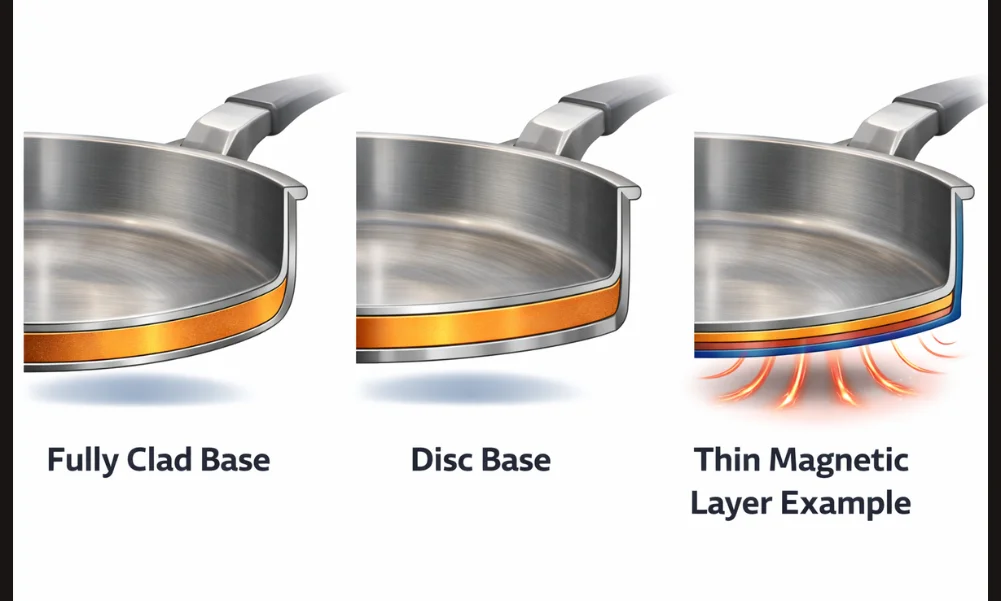
Base construction affects how evenly cookware heats on induction.
A thin base may heat too quickly in the center and develop hot spots. This is also one reason cookware can warp over time, especially when rapid heat changes are combined with weak construction; see cookware warping causes and prevention for more detail.
A warped base may lose stable contact with the cooktop. A poorly bonded disc base may heat unevenly or separate over time.
Fully clad cookware usually spreads heat through the sides and base more evenly. Disc-base cookware can also work well if the disc is thick, wide, and strongly bonded.
For induction cooking, the best cookware is not just magnetic. It should also be flat, stable, properly sized, and built to handle rapid energy transfer.
Common Induction Cookware Materials Explained
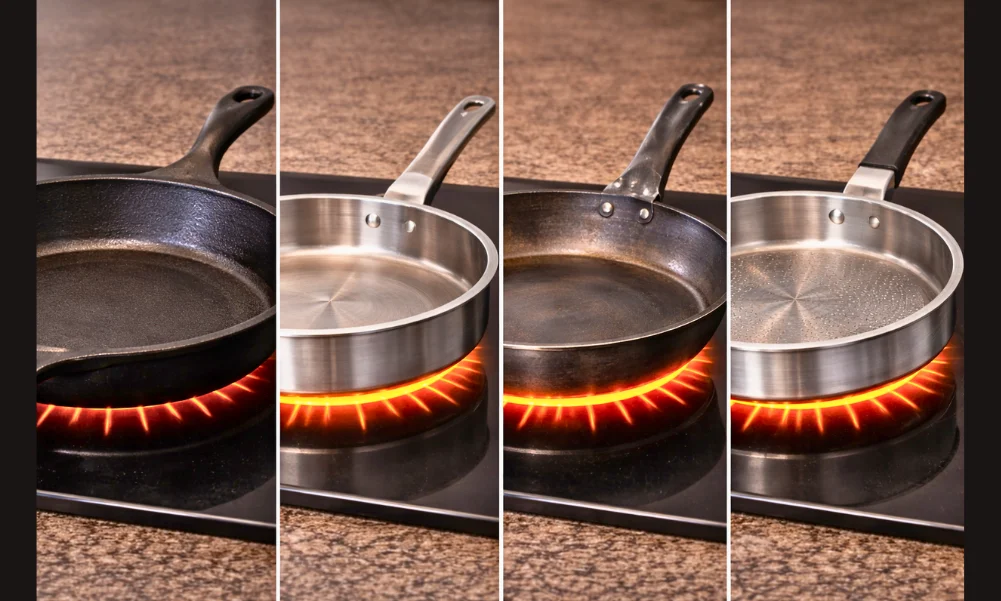
Different cookware materials behave differently on induction. Compatibility depends on magnetism, but performance depends on construction.
| Material | Works on Induction? | Strength | Limitation | Best For |
|---|---|---|---|---|
| Cast iron | Yes | Excellent heat retention | Heavy and slower to adjust | Searing, frying, skillet cooking |
| Carbon steel | Yes | Responsive and lighter than cast iron | Needs seasoning and care | Stir-frying, searing, quick cooking |
| Stainless steel | Sometimes | Durable and versatile | Not all stainless steel is magnetic | Everyday cooking |
| Fully clad stainless steel | Usually | Better heat spread | Higher price | Most home cooks |
| Aluminum with magnetic base | Sometimes | Lightweight and often affordable | Performance depends on base quality | Nonstick and everyday pans |
| Copper with magnetic base | Sometimes | Excellent heat control | Expensive and construction-dependent | Precision cooking |
| Glass or ceramic | No | Not applicable | Not magnetic | Not suitable without adapter |
Stainless Steel
Stainless steel cookware varies widely. Some stainless steel pans work on induction, while others do not. Fully clad stainless steel usually performs better because it spreads heat more evenly.
If stainless steel is your preferred everyday option, compare construction and use cases in our guide to stainless steel cookware sets.
Cast Iron
Cast iron is naturally magnetic and works well on induction. It holds heat strongly, making it useful for searing and frying. Because it is heavy, it should be lifted rather than dragged across the glass surface.
Carbon Steel
Carbon steel is also naturally magnetic. It responds faster than cast iron but still needs seasoning and proper care.
If you are deciding between heavier heat retention and faster response, our carbon steel vs cast iron cookware comparison explains the trade-offs clearly.
Aluminum
Aluminum does not work on induction unless it has a magnetic base layer. Many induction-compatible nonstick pans use aluminum bodies with bonded magnetic discs.
For a practical comparison of these two common cookware materials, see aluminum vs stainless steel cookware.
Copper
Copper also needs a magnetic base layer to work on induction. The Copper can still help with heat control, but only if the cookware is designed for induction use.
Copper also has special maintenance and performance considerations, which are covered in copper cookware performance and maintenance.
What Induction Cookware Does Not Mean
Induction-compatible does not automatically mean high quality.
- It does not mean the pan will never warp.
- Does not mean the pan will heat evenly.
- It does not mean the nonstick coating is more durable.
- Does not mean the cookware is safer than other cookware.
- It does not mean the pan is worth a higher price.
Induction compatibility is a function requirement. Quality still depends on material, thickness, bonding, handle construction, coating durability, and long-term heat resistance.
How Induction Compatibility Affects Cooking Behavior
Induction changes how cookware responds to heat.
On gas or traditional electric burners, heat usually builds more gradually. On induction, compatible cookware can respond almost immediately. This makes cooking feel faster and more precise, but it also leaves less room for careless heat control.
Common behavior changes include:
- water boils faster
- pans preheat quickly
- searing happens sooner
- simmering needs finer adjustment
- thin pans may show hot spots faster
- empty cookware can overheat quickly
This does not mean induction is difficult. It means the cookware and technique need to match the speed of the cooktop.
How to Tell If Existing Cookware Will Work on Induction
The easiest way to test existing cookware is with a magnet.
Turn the pan upside down and place a magnet on the base. If the magnet sticks firmly, the pan will usually work on induction. If the magnet falls off or barely sticks, the cookware may not be compatible.
Also check the shape of the base. A pan should sit flat and stable on the cooktop. If it rocks, wobbles, or has a warped bottom, it may heat unevenly even if it passes the magnet test.
Manufacturer markings can help, especially the induction symbol, but they are not always necessary. The magnet test is usually the fastest practical check.
Can You Use Regular Cookware on an Induction Cooktop?
Yes, regular cookware can work on an induction cooktop if the base contains magnetic material.
Many cast iron, carbon steel, and stainless steel pans already work on induction. You do not always need cookware labeled specifically as “induction cookware.”
However, regular aluminum, copper, glass, and ceramic cookware will not work unless they include a magnetic base layer or are used with an induction adapter plate.
The best approach is simple: test your existing cookware first. If your main skillet, saucepan, and stockpot pass the magnet test and sit flat, you may not need to replace them.
Why Your Induction Cooktop Is Not Detecting a Pan
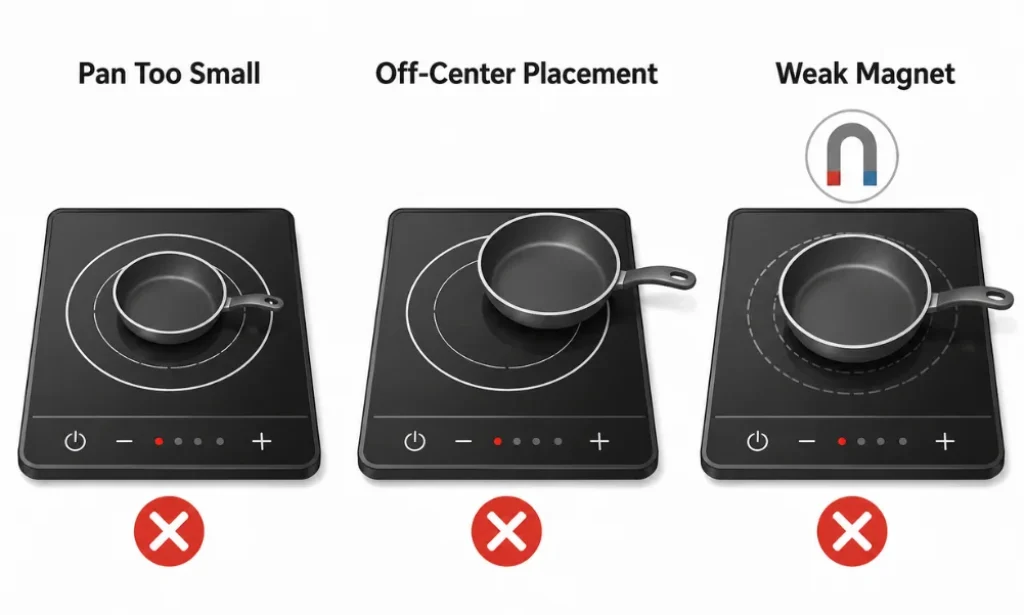
If your induction cooktop does not recognize a pan, the problem is usually related to compatibility, size, or contact.
Common reasons include:
| Problem | What It Means | Fix |
|---|---|---|
| Magnet does not stick | The pan is not magnetic | Use compatible cookware |
| Magnet sticks weakly | Magnetic layer may be too thin | Try a stronger induction pan |
| Pan base is too small | Cooktop sensor may not detect it | Use a larger pan |
| Pan is off-center | Sensor alignment is poor | Center the pan on the burner |
| Pan is warped | Poor contact with cooktop | Use a flat-bottom pan |
| Magnetic disc is too small | Only the center receives energy | Choose cookware with a wider magnetic base |
| Adapter plate is used | Heat transfer becomes indirect | Use only when necessary |
A pan can pass the magnet test and still perform poorly if the magnetic area is too small or the base is thin.
Can Induction Damage Cookware?
Induction does not automatically damage cookware. Most damage happens when cookware is used in ways that create sudden stress.
Common causes of cookware damage on induction include:
- preheating an empty pan on high power
- using very thin cookware
- placing cold food or liquid into an overheated pan
- dragging heavy cast iron across the glass
- using cookware with a warped base
- overheating nonstick coatings
- using a pan much smaller than the active burner area
To protect cookware, start with moderate heat, avoid long empty preheating, match pan size to burner size, and lift heavy pans instead of sliding them.
For a fuller breakdown of avoidable user errors, read induction cooking mistakes that damage cookware.
Common Buyer Misconceptions About Induction Cookware
1: Induction cookware is always better
Induction cookware is not automatically better. It is simply compatible with induction cooking. Quality depends on construction.
2: If a pan is expensive, it must work on induction
Price does not guarantee compatibility. Some expensive copper or aluminum cookware will not work unless it has a magnetic base.
3: A magnet test proves the pan is high quality
The magnet test only shows compatibility. It does not prove even heating, durability, or warp resistance.
4: All stainless steel works on induction
Not all stainless steel is magnetic. Some stainless steel pans work well; others do not.
5: You must replace every pan
Many people only need to replace one or two pieces. Test your current cookware before buying a full set.
How Induction Cookware Fits Into Long-Term Ownership
Induction cooking rewards good cookware construction and careful heat control.
A well-built induction-compatible pan can last for years if it has a stable base, strong bonding, and appropriate material thickness. For realistic lifespan expectations by material and construction, see how long cookware should last.
Poorly made cookware may still work at first but show problems over time, such as warping, hot spots, loose handles, or coating breakdown.
For long-term ownership, focus on:
- flat base stability
- strong magnetic response
- durable handle attachment
- suitable weight
- coating quality if buying nonstick
- oven-safe limits if needed
- cleaning and maintenance requirements
- warranty or brand support
The best induction cookware is not just the pan that activates the burner. It is the pan that continues to cook evenly and safely after repeated use.
Induction Cookware in One Sentence
Induction cookware is cookware with a magnetic base that can receive energy from an induction cooktop, but how well it performs depends on construction quality, flatness, thickness, and cooking technique.
Cookware That Works Well on Induction Cooktops
Most cookware made with magnetic materials can work on induction, but each material has different strengths.
Best for Everyday Cooking: Fully Clad Stainless Steel
Fully clad stainless steel is a strong choice for most home cooks because it is durable, versatile, and usually distributes heat better than thin disc-base cookware.
Best for Searing: Cast Iron
Cast iron works naturally on induction and holds heat very well. It is ideal for searing, frying, and high-heat skillet cooking.
Best for Fast Response: Carbon Steel
Carbon steel is lighter and more responsive than cast iron. It works well for stir-frying, searing, and quick adjustments, but it needs seasoning.
Best for Easy Cleanup: Induction-Compatible Nonstick
Nonstick cookware can work on induction if it has a magnetic base. It is useful for eggs, pancakes, and delicate foods, but avoid overheating it.
If coating safety is your main concern, start with our guide to the safest non-stick cookware.
Best Budget Approach: Test Before Replacing
Before buying a complete cookware set, test your existing pans. If only one pan fails, replacing that single piece may be smarter than buying a full set.
Recommended next reading:
- Cookware Types Explained
- Best Cookware Sets
- Cookware Material Matrix: How to Choose
- How We Choose the Best Cookware
Induction Cookware Buying Checklist
Before buying induction cookware, check these points:
| Buying Factor | Why It Matters |
|---|---|
| Magnetic base | Required for induction compatibility |
| Flat bottom | Improves contact and stability |
| Proper diameter | Helps cooktop detection |
| Thick or well-bonded base | Reduces hot spots and warping |
| Material type | Affects weight, response, care, and durability |
| Handle comfort | Important for daily use |
| Oven-safe rating | Useful if finishing dishes in the oven |
| Lid fit | Helps simmering and moisture control |
| Cleaning requirements | Affects long-term convenience |
| Warranty | Adds buyer confidence |
If you are replacing cookware for induction, start with the pan you use most often. Before buying a complete set, compare the pros and cons of a cookware set vs individual pieces.
For most kitchens, that means a skillet, saucepan, or sauté pan.
Closing Summary
Induction cookware works because its base responds to magnetic energy from an induction cooktop. The pan becomes the heat source, which is why induction cooking feels fast, responsive, and efficient.
Compatibility depends on magnetic material, but performance depends on more than magnetism. A good induction pan should also have a flat base, strong construction, proper thickness, and stable contact with the cooktop.
Before buying anything new, test your existing cookware with a magnet. If your pans are magnetic, flat, and properly sized, they may already work. If they do not, replace cookware strategically instead of assuming you need a full new set.
The simplest rule is this: a magnet tells you whether a pan can work on induction; construction quality tells you how well it will cook.
Frequently Asked Questions About Induction Cookware
What is induction cookware?
Induction cookware is cookware with a magnetic base that can respond to the electromagnetic field of an induction cooktop. The pan heats directly instead of relying on a hot burner surface.
How do I know if cookware is induction-compatible?
Place a magnet on the bottom of the pan. If the magnet sticks firmly, the cookware will usually work on induction.
Does the magnet test prove cookware is good quality?
No. The magnet test only confirms likely compatibility. It does not prove even heating, durability, warp resistance, or overall cooking performance.
Does stainless steel work on induction?
Some stainless steel cookware works on induction, but not all. Compatibility depends on the alloy and whether the base contains magnetic material.
Does cast iron work on induction?
Yes. Cast iron is naturally magnetic and usually works well on induction. Because it is heavy, lift it instead of dragging it across the glass surface.
Does carbon steel work on induction?
Yes. Carbon steel is magnetic and works well on induction. It heats faster than cast iron but needs seasoning and care.
Can aluminum cookware work on induction?
Aluminum does not work on induction by itself. It needs a magnetic base layer bonded to the bottom.
Can copper cookware work on induction?
Copper cookware needs a magnetic base layer to work on induction. Pure copper is not magnetic.


Content is researched and written by Engr. Jamal & KitchenMarks Editorial team based on hands-on product use, maintenance experience, and long-term household performance evaluation.


