

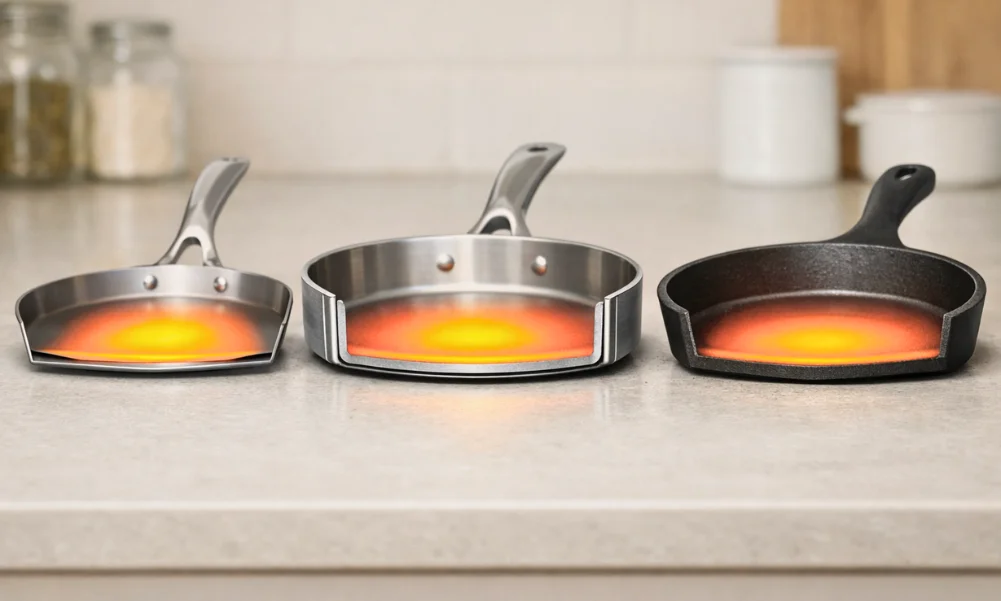
Quick Answer: What Actually Controls Heat Distribution in Cookware
Heat distribution in cookware depends on material conductivity, thickness, core design, and pan geometry. Even heating is not about speed, but about how evenly heat spreads and remains stable over time.
Thicker cookware heats more slowly but reduces hot spots across the cooking surface. Multi-layer cores move heat laterally, smoothing temperature differences from the center to the edges.
Thin, single-metal pans react quickly but amplify burner patterns and temperature swings. Good heat distribution improves cooking consistency, not speed, during everyday use.
What Heat Distribution Means in Cookware
Heat distribution describes how evenly heat spreads across the surface of a pan after energy enters the metal.
Cookware with good heat distribution spreads energy from the heat source across the entire base, reducing hot spots and improving cooking consistency.
Why Heat Distribution Matters in Real Kitchens
Uneven heat creates hot spots that burn food before the rest finishes cooking evenly. This behavior causes sticking, scorched sauces, and inconsistent browning.
Poor heat distribution increases oil breakdown during high-heat cooking. That breakdown affects flavor, smoke, and long-term cookware wear.
Heat behavior matters most during tasks with little liquid or frequent temperature changes. Searing, frying eggs, and reducing sauces expose distribution weaknesses quickly.
Long simmering reveals stability problems when heat pools in one area. Consistent distribution reduces error margins, especially for daily-use cooking.
It allows lower settings to work predictably without constant adjustment. Understanding distribution helps explain why similar-looking pans perform very differently.
This foundation supports smarter choices before comparing materials, thickness, or construction methods.
Heat Transfer Basics (Without Physics Overload)
Heat reaches cookware through conduction rather than instant surface contact. The cooktop supplies energy, while the pan determines how that energy spreads.
Fast conduction moves heat quickly into the metal but does not guarantee even cooking. Lateral heat flow determines whether heat spreads evenly across the base.
Vertical heat flow affects how quickly heat reaches sidewalls and food edges. Thin cookware favors speed but reflects burner shape more aggressively.
Thicker cookware dampens spikes and smooths uneven input from the cooktop. Cooktop type also changes how heat enters the pan.
Gas flames concentrate heat at contact points along the base. Electric coils deliver heat in defined rings that exaggerate hot zones.
Induction transfers energy directly into the metal, highlighting construction quality. These differences explain why the same pan behaves differently across cooktops.
System-level behavior connects naturally with how-heat-transfers-from-cooktops-to-cookware. Burner size mismatch further complicates distribution by overloading pan centers.
That stress pattern becomes clearer through burner-size-heat-zones-pan-stability behavior.
What Controls Heat Distribution
Cookware Thickness: The Most Misunderstood Variable
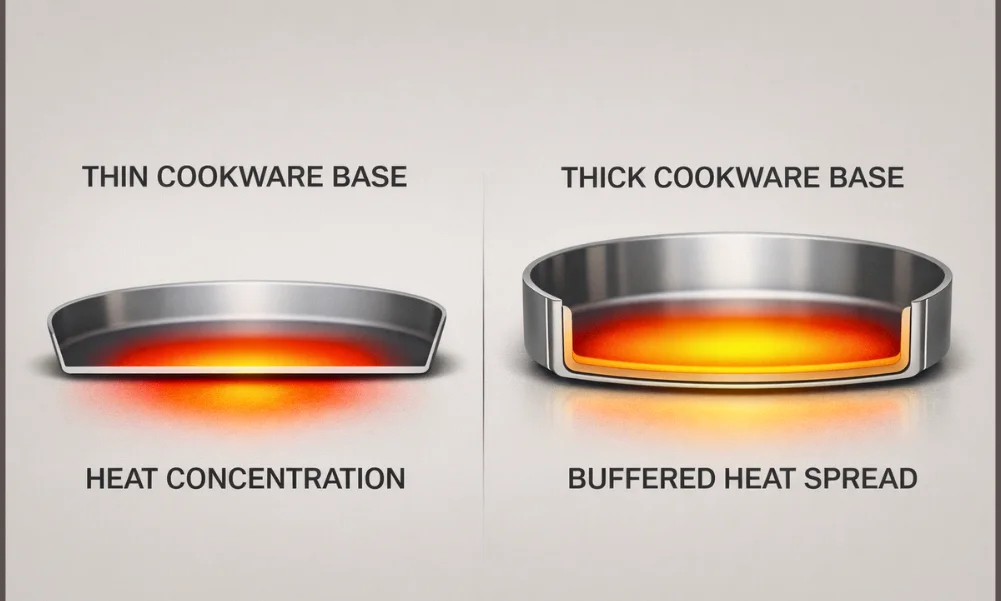
Thickness controls how cookware buffers incoming heat. Thicker bases absorb energy and release it more gradually.
This buffering reduces temperature spikes during burner adjustments. Thin cookware responds faster but mirrors heat input without moderation.
That responsiveness increases hot spots during high-heat cooking. Thickness also improves stability when cooking over uneven heat sources.
Heavier cookware tolerates minor misuse without immediate performance loss. Lightweight cookware demands closer attention to heat settings.
Thickness does not improve conductivity but improves heat control. This distinction explains why thicker pans feel more forgiving in daily use.
Structural differences are explored further in cookware thickness heat control.
Core Construction: Single Metal vs Multi-Layer
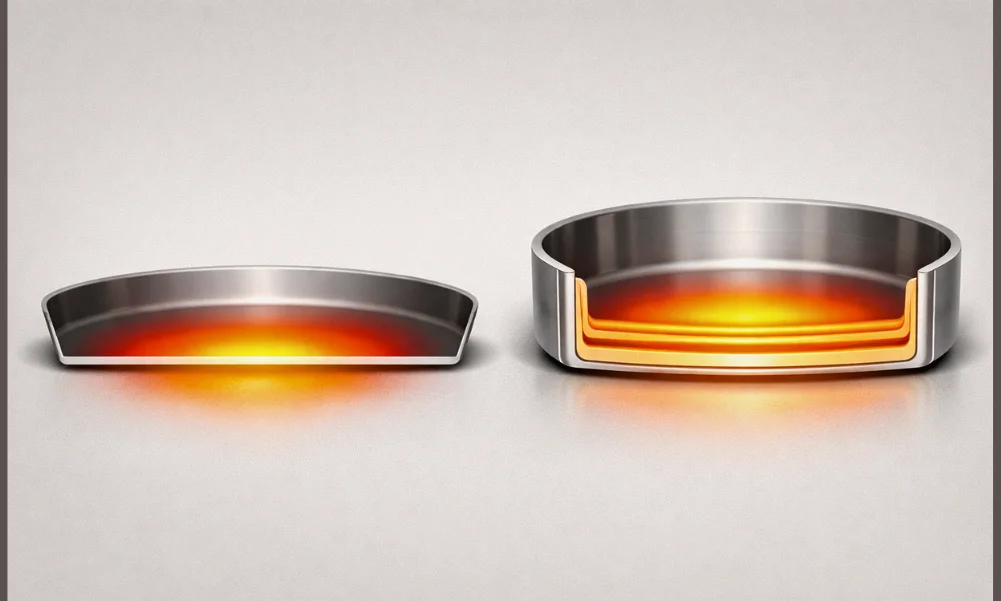
Core construction determines how heat spreads once it enters the cookware. Single-metal cookware relies entirely on one material’s natural behavior.
Aluminum-only pans conduct heat quickly but struggle to distribute it evenly. Stainless-only cookware offers structure but resists heat flow across the surface.
Cast iron and carbon steel spread heat slowly but stabilize it well after preheating. Multi-layer construction changes how heat moves laterally across the base.
Aluminum or copper cores act as heat highways between hot and cool zones. Fully clad cookware spreads heat more evenly than disc-bottom designs.
Disc bases improve center heating but leave edges less supported. Clad sidewalls reduce edge cooling during sautéing and simmering.
Construction quality matters more than layer count alone. Material behavior comparisons often connect with aluminum vs stainless steel cookware.
Material Conductivity Comparison (Behavior-Based)
Materials move heat at different speeds and with different stability. Copper spreads heat very quickly but stores little energy.
Aluminum conducts heat well and responds quickly to adjustments. Stainless steel conducts poorly but adds structural strength.
Cast iron conducts slowly yet retains heat exceptionally well. Carbon steel balances faster response with moderate retention.
High conductivity improves responsiveness but exaggerates uneven input. High retention improves stability but slows temperature changes.
Balanced cookware combines conduction with buffering rather than extremes. Performance depends on how these traits interact with thickness and core design.
Readers often explore coated versus uncoated behavior through stainless steel vs non stick cookware.
Why Hot Spots Form (And Why Some Pans Never Fix Them)
Hot spots form when heat enters cookware faster than it can spread laterally. Thin bases allow burner patterns to imprint directly onto the cooking surface.
Narrow burners overload the center while edges remain underheated. Induction coils intensify this effect when pan bases lack sufficient mass.
Warped cookware worsens distribution by breaking contact with the heat source. Even small deformations redirect energy into uneven paths.
Empty heating accelerates hot spot formation by removing thermal buffering. Repeated exposure reinforces these stress patterns over time.
Some pans cannot correct hot spots because construction limits heat flow. Thickness and core design define whether redistribution is possible.
Warping behavior is further explained through cookware warping causes prevention. Empty heating effects are clarified in heating empty cookware risk.
Heat Distribution vs Heat Retention (Why They Are Not the Same)
Heat distribution and heat retention describe different performance traits. Distribution explains how evenly heat spreads across the pan.
Retention explains how long that heat remains once absorbed. Cast iron distributes heat slowly but feels even after preheating.
Aluminum distributes heat quickly but loses it rapidly during adjustments. High retention masks uneven input by stabilizing temperature.
Low retention reveals fluctuations immediately. Neither trait is superior without considering cooking style.
Understanding this difference prevents misinterpreting performance as material failure.
Pan Shape and Geometry Effects
Pan geometry influences how heat spreads after entering the cookware. Flat bases promote uniform contact with most cooktops.
Rounded or crowned bases concentrate heat toward the center. Thicker sidewalls retain heat longer near edges.
Thin sidewalls cool faster and pull heat away from the base. Flared walls increase evaporation and reduce edge heat buildup.
Straight walls trap heat but amplify hot zones during searing. Edge tapering affects how quickly heat migrates upward.
Similar materials perform differently when geometry changes heat flow paths.
How Different Cooking Tasks Stress Heat Distribution
Cooking tasks apply different stress patterns to cookware surfaces. Searing proteins demands rapid, even heat across the base.
Uneven distribution causes patchy browning and sticking. Frying eggs exposes hot spots immediately due to low moisture.
Sauce simmering tests lateral heat flow and temperature stability. Stir-frying stresses edge heating during constant motion.
Low-liquid cooking magnifies burner imprinting effects. High-heat tasks reveal weaknesses faster than gentle simmering.
Practical context aligns with cookware for frying materials comparisons. Egg behavior under uneven heat appears in eggs sticking stainless steel.
Sticking patterns trace back to distribution issues discussed in why food sticks to stainless steel.
Cooktop Type and Distribution Mismatch
Cooktop design influences how heat enters cookware before distribution begins. Gas flames apply heat unevenly across exposed contact points.
Electric coils deliver energy in defined rings that exaggerate hot zones. Radiant glass cooktops introduce lag that delays temperature correction.
Induction cooktops heat the metal directly rather than the surface beneath. This precision magnifies differences in thickness and core construction.
Thin cookware reflects coil patterns more clearly on induction. Thicker or clad cookware smooths those patterns before food contact.
Burner size mismatches overload pan centers with excess energy. Larger pans suffer edge cooling when burners fail to cover the base.
System behavior is clarified through what is induction cookware and how does it work. Common misuse patterns appear in induction cooking mistakes damage cookware.
When Thickness and Core Stop Helping
Thicker cookware does not solve every heat distribution problem. Excessive thickness increases weight without improving lateral heat flow.
Very heavy cookware responds slowly to temperature changes. That lag complicates delicate cooking and quick adjustments.
Core layers reach diminishing returns beyond functional thickness. Poor geometry cannot be fixed by added mass alone.
Uneven cooktop contact still creates hot zones. Weight also affects handling, fatigue, and daily usability.
Balance matters more than maximum thickness. Effective cookware matches construction to cooking demands.
Choosing Cookware Based on Heat Distribution Needs
Heat distribution needs vary with experience level and cooking frequency. Beginners benefit from cookware that buffers temperature swings.
Thicker bases reduce error during heat adjustments. Experienced cooks often prefer faster response and lighter handling.
High-heat cooking demands stable distribution to avoid scorching. Low-heat cooking relies on even lateral heat flow for consistency.
Daily-use cookware must balance stability with manageable weight. Specialty cookware can accept narrower performance windows.
Matching construction to habits improves results without complexity. Decision frameworks align with choose cookware by cooking style guidance.
Safety and Longevity Perspective
Even heat distribution reduces localized overheating. Localized overheating accelerates coating wear and structural stress.
Thin cookware increases misuse risk under high heat. Stable heat lowers oil breakdown and smoke generation.
Better distribution supports predictable, repeatable outcomes. Longevity depends more on heat behavior than brand positioning.
Misuse shortens lifespan faster than normal wear. Understanding distribution prevents unnecessary replacement.
This framing supports safety without fear-based language.
How to Recognize Good Heat Distribution When Buying Cookware
Heat distribution cannot be judged by marketing language alone. Instead, look for structural clues:
- thicker bases that buffer heat input
- aluminum or copper cores that move heat laterally
- fully clad construction that spreads heat into sidewalls
- flat bases that maintain contact with the cooktop
These features improve distribution more reliably than brand claims or coating types.
Related Cookware Guides
Understanding heat distribution helps explain why different cookware performs differently in real kitchens.
These guides apply the same principles when comparing cookware options:
- Best Cookware Sets for Home Kitchens
- Best Stainless Steel Cookware for Even Heating
- Best Cookware for Induction Cooktops
Each guide evaluates cookware construction using the heat behavior explained above.
Closing Summary
Heat distribution depends on material behavior, thickness, and core design. Even heating reflects structure rather than marketing claims.
Thickness buffers heat while cores spread it laterally. No single construction suits every cooking task.
Performance improves when cookware matches real cooking habits. Understanding heat behavior leads to safer, longer-lasting cookware use.


