Quick Answer
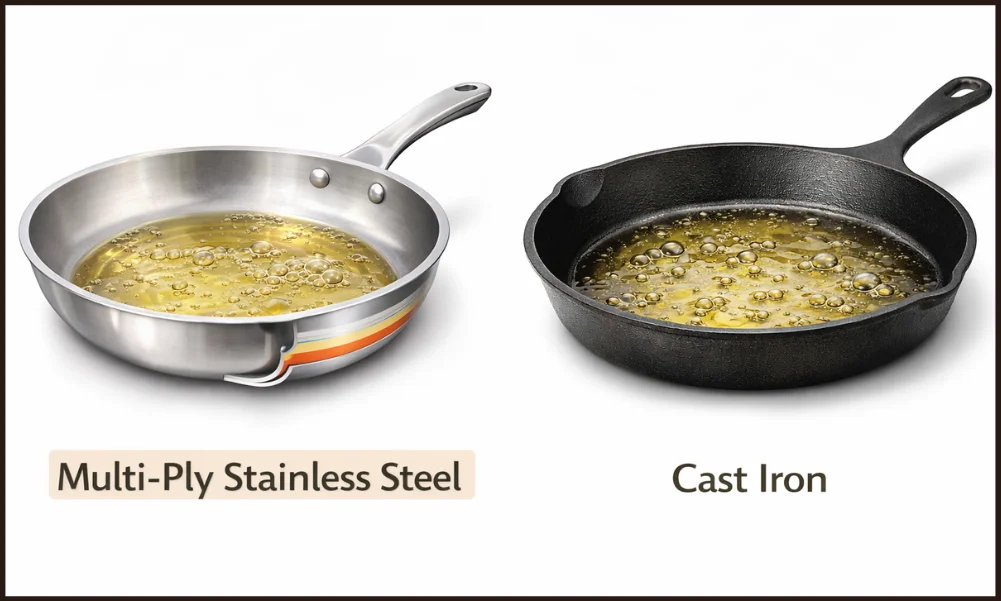
The best oil depends on the cookware material, the heat level, and the cooking goal. Oil choice affects how food releases, how residue builds up, and how cookware ages over time. Smoke point matters, but it is not the only factor. Matching oil behavior to cookware surface and heat range leads to better performance and easier maintenance.
Why Oil Choice Matters for Cookware
Oil acts as a bridge between food and cookware. It transfers heat, reduces friction, and protects surfaces from direct contact. When oil choice aligns with cookware material and temperature, cooking feels controlled. When it does not, sticking, residue, and discoloration become more common.
Different cookware materials interact with oil in different ways. Non-stick surfaces rely on oil to reduce wear rather than create release. Stainless steel uses oil to manage controlled sticking. Cast iron and carbon steel depend on oil to maintain seasoning. In each case, oil supports the surface rather than replacing good technique.
Oil also influences how cookware ages. Oils that break down too early leave sticky residues. Those residues polymerize and darken surfaces over time. This process connects closely to cookware discoloration, which often reflects repeated oil breakdown rather than damage. See Cookware Discoloration: Causes and Safe Cleaning Methods for practical examples.
A helpful metaphor is to think of oil as the right shoes for the terrain. Hiking boots work well on trails but feel heavy on pavement. Running shoes feel light but wear quickly on rocks. The oil that performs well in one context may struggle in another.
Understanding this interaction helps buyers move away from rigid rules and toward flexible, material-aware choices.
Understanding Smoke Point Without Oversimplifying
Smoke point is often treated as a single decision-making number. In reality, it is a guideline rather than a guarantee.
Smoke point refers to the temperature at which oil begins to visibly smoke under test conditions. Real cooking rarely happens under those exact conditions. Pan shape, food moisture, burner output, and airflow all change how oil behaves.
More importantly, repeated overheating matters more than brief exposure. An oil pushed near its limit over and over will degrade faster, even if it never visibly smokes. This degradation leaves residues that affect both cooking performance and cleanup.
High smoke point oils are useful for sustained high heat. They are not automatically better for all tasks. In moderate heat cooking, oils with lower smoke points can perform well and leave fewer residues.
This nuance explains why oil choice is about fit, not ranking. Matching oil behavior to cookware and cooking style leads to better results than chasing the highest number. Smoke point should be treated as a stress threshold, not a performance rating.
Best Oils by Cookware Material
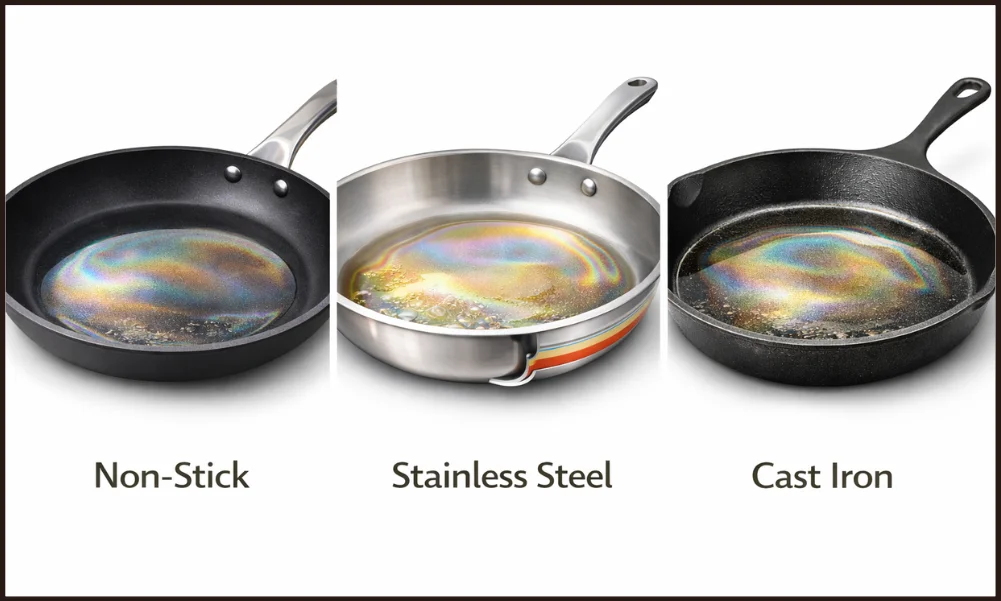
Oil performance varies because cookware materials differ in surface structure, heat response, and maintenance needs, as explained in Cookware Types Explained: Materials, Uses, and Limitations. Different cookware materials respond best to different oil behaviors. Matching oil to surface and heat range improves cooking control and reduces long-term wear.
| Cookware Material | Oil Behavior to Look For |
|---|---|
| Non-stick | Stable at low–moderate heat |
| Stainless steel | Even spread, wide heat tolerance |
| Cast iron | Predictable polymerization |
| Carbon steel | Fast polymerization, clean burn |
| Enameled cast iron | Moderate heat, low residue |
| Lined copper | Stability during rapid heat shifts |
Non-Stick Cookware
Non-stick cookware performs best at low to moderate heat. Oils that remain stable in this range help protect the coating and reduce residue buildup.
Very high-heat oils offer little advantage here. They are designed for temperatures that non-stick cookware should not routinely reach. When overheated, these oils can still degrade and leave films that are difficult to remove.
Using appropriate oils supports coating longevity and aligns with guidance on when to replace non-stick cookware, which focuses on wear patterns rather than isolated mistakes.
Stainless Steel Cookware
Stainless steel benefits from oils that tolerate a wide heat range and help manage controlled sticking. These oils create a thin barrier that allows food to release once proteins set.
At higher heat, stable oils reduce the risk of burned-on residue. At moderate heat, oils that spread evenly help prevent patchy sticking. Stainless steel’s durability gives flexibility, but oil choice still influences cleanup and surface appearance.
Cast Iron Cookware
Cast iron relies on oil as part of its seasoning system. Oils that polymerize predictably under heat help maintain a stable cooking surface.
Oils that break down too early leave sticky layers instead of smooth seasoning. Over time, this leads to uneven texture and darker patches that affect cooking feel rather than safety.
Oil choice here is less about immediate results and more about long-term surface development.
Carbon Steel Cookware
Carbon steel behaves like a lighter, faster-responding version of cast iron. It benefits from similar oil characteristics but reacts more quickly to heat changes.
Oils that support even polymerization help build seasoning without excessive buildup. Because carbon steel heats quickly, heat control and oil choice work together to prevent residue.
Enameled Cast Iron
Enameled cast iron does not require seasoning. Oil choice is therefore focused on cooking performance rather than surface maintenance.
Moderate-heat oils that resist burning reduce residue on the enamel surface. Overheating oils can leave stubborn stains that connect to cookware discoloration, even when the enamel remains intact.
Copper Cookware (Lined)
Copper cookware behavior is governed by its lining, not the copper itself. Oil choice should match the lining material, which is commonly stainless steel.
Because copper responds rapidly to heat changes, oils that remain stable during quick temperature shifts improve control and reduce scorching.
Oils That Commonly Cause Problems
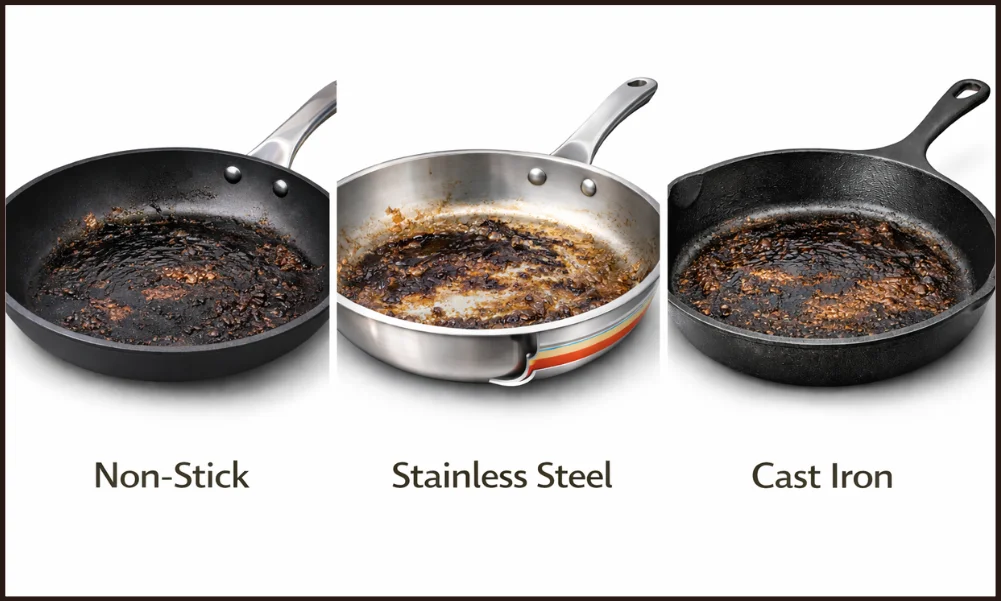
Problems arise when oil behavior does not match cookware or heat level.
Low smoke point oils used at high heat break down quickly. This breakdown creates sticky residues that bond to cookware surfaces. Over time, these residues darken and become harder to remove.
Repeated overheating of any oil accelerates this process. Even oils with higher smoke points leave residue when pushed beyond their comfort zone too often.
Another common issue is using oil as a substitute for heat control. Oil cannot compensate for excessive temperature. When heat management is off, residue and discoloration follow regardless of oil choice.
Recognizing these patterns helps reduce frustration and unnecessary cleaning effort.
What Oil Choice Does Not Control
Oil choice cannot fix damaged cookware. It cannot restore worn non-stick coatings. It cannot correct warped pans or loose handles.
Oil also does not eliminate the need for appropriate heat control. Poor temperature management overrides even the best oil selection.
Understanding these limits prevents unrealistic expectations and supports better overall cooking habits.
How Oil Choice Fits Into Cookware Care
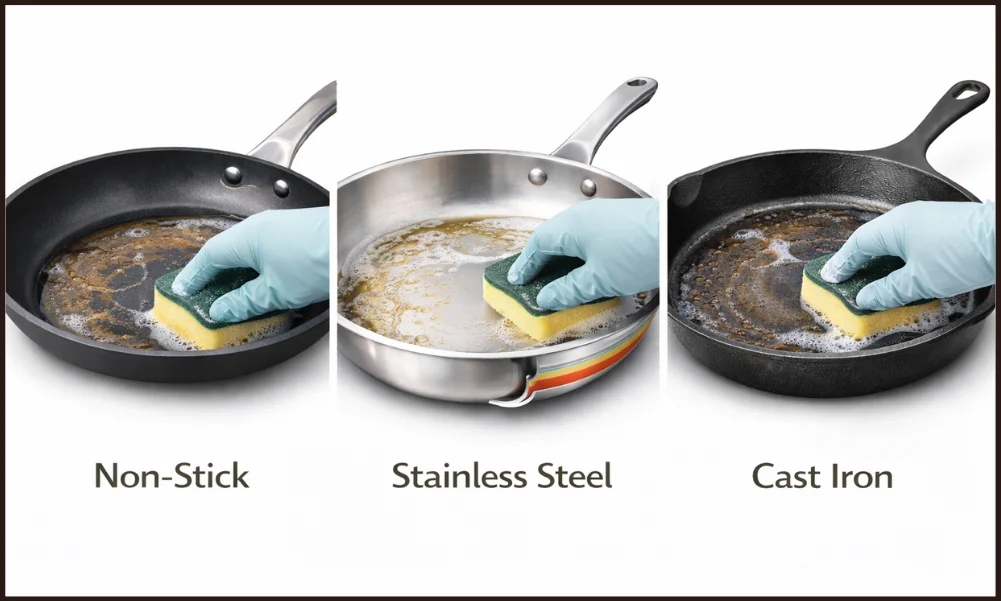
Oil choice influences how often cookware discolors, how easily it cleans, and how evenly it cooks over time.
Using oils within their effective heat range reduces residue buildup. This makes cleaning gentler and extends functional lifespan. It also reduces the likelihood of stains that lead buyers to question safety unnecessarily.
Oil choice works alongside other habits, such as heat moderation and cleaning method. Together, these factors shape long-term performance more than any single decision.
Common Buyer Misconceptions About Cooking Oils
One misconception is that higher smoke point oils are always better. Another is that one oil works equally well for all cookware. A third is that oil choice is only about nutrition rather than cookware behavior.
These simplifications lead to mismatches between oil, heat, and surface. Replacing them with context-based thinking improves results without added complexity.
Closing Summary
The best oil depends on cookware material, heat level, and cooking purpose. Smoke point matters, but it is only one part of the picture.
Matching oil behavior to cookware surface reduces sticking, residue, and discoloration. It also supports realistic longevity by minimizing unnecessary wear.
By treating oil choice as a performance tool rather than a ranking exercise, buyers can cook with more control and maintain their cookware more confidently.