Quick Answer
Cookware warping is a permanent change in shape caused by uneven heating and thermal stress. It most often occurs when cookware is thin, overheated, or exposed to rapid temperature changes.
Some materials are more prone to warping than others. While minor warping can sometimes be managed, severe warping cannot be reliably fixed and usually signals that replacement is the safer option.
Durability and maintenance are key factors when choosing the best cookware for long-term use.
What Cookware Warping Means
Warping occurs when a pan no longer sits flat due to permanent deformation of the metal. This is not the same as temporary movement caused by heat expansion during cooking. True warping remains after the cookware has cooled.
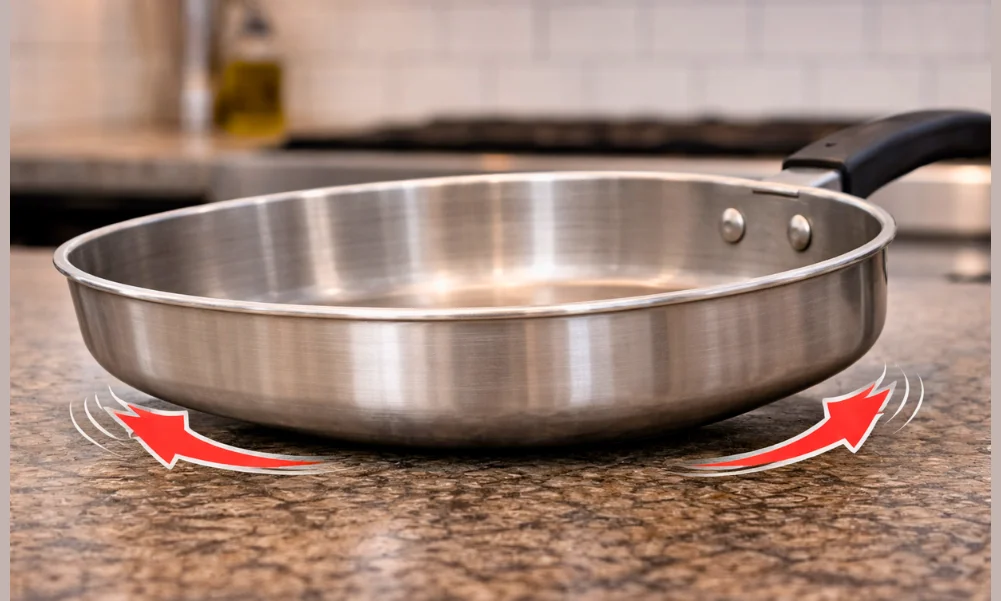
A warped pan often rocks on a flat surface or spins instead of staying stable. On certain stovetops, this can reduce heat contact and cooking efficiency. On others, it can create safety concerns if the pan becomes unstable.
Warping happens because different parts of a pan expand and contract at different rates. When that stress exceeds the metal’s ability to return to its original shape, the change becomes permanent.
Warping risk is closely tied to cookware material and construction choices, which shape how metals respond to heat, as explained in Cookware Types Explained: Materials, Uses, and Limitations.
A useful way to think about warping is as fatigue from uneven stress. The metal is not breaking, but it is being pushed beyond its elastic limits in specific areas.
Primary Causes of Cookware Warping

The most common cause of warping is rapid temperature change. Placing a cold pan on a hot burner, or a hot pan under cold water, creates uneven expansion that stresses the metal.
High heat applied to thin cookware is another major factor. Thin bases heat quickly but lack the mass needed to distribute heat evenly. This concentrates stress in the hottest areas, usually the center of the pan.
Thin cookware heats quickly but lacks the thermal buffer that helps distribute heat evenly, a behavior explained in more detail in Cookware Thickness Explained: Why It Affects Heat Control.
Uneven burners can also contribute. When heat is focused on a small area instead of spread across the base, localized expansion increases warping risk.
Warping is rarely the result of a single mistake. It usually develops over repeated cycles of stress that gradually change the pan’s shape.
Material-Specific Warping Risks
Not all cookware materials respond to heat stress in the same way. Warping risk depends on a combination of conductivity, thickness, and structural stiffness.
Aluminum is the most warp-prone material. It conducts heat efficiently but is relatively soft. Thin aluminum pans heat quickly and expand unevenly, especially on high heat. Thicker or cast aluminum resists warping better, but repeated stress can still cause deformation over time.
Stainless steel is stiffer than aluminum but conducts heat poorly on its own. Thin stainless steel pans without a thick core are vulnerable to hot spots, which can lead to localized expansion and warping. Multi-layer construction reduces this risk by spreading heat more evenly.
Carbon steel falls between aluminum and cast iron. It is thinner than cast iron but stronger than aluminum. Carbon steel can warp if overheated or cooled too quickly, particularly in larger pans. Gradual heating and adequate thickness reduce risk.
Cast iron is the least likely to warp because of its thickness and rigidity. Its mass resists deformation, even under high heat. However, cast iron can crack if subjected to extreme thermal shock, which is a different failure mode.
Understanding these differences helps buyers set realistic expectations. Warping risk is not a flaw in the material. It is a consequence of how the material is used.
Prevention Strategies That Actually Work

Preventing warping relies more on habit than on equipment upgrades. Small changes in how cookware is heated and cooled make a meaningful difference.
Gradual heating is the most effective prevention step. Allowing a pan to warm up slowly gives the metal time to expand evenly. Jumping straight to high heat increases stress before the material can stabilize.
Matching pan size to burner size also matters. Heat concentrated in the center of a pan creates uneven expansion. Using a burner that closely matches the pan’s base reduces localized stress.
Flat contact is especially important on induction cooktops, where uneven bases can amplify stress, a problem explored further in Induction Cooking Mistakes That Damage Cookware.
Cooling practices are just as important. Placing a hot pan on a room-temperature surface and allowing it to cool naturally is safer than rinsing it under cold water. Sudden cooling locks in deformation.
Thickness plays a supporting role. Thicker bases distribute heat more evenly and tolerate stress better. This does not make them immune, but it raises the margin for error.
A useful way to think about prevention is to avoid shortcuts that save seconds but cost years of lifespan.
Can Warped Cookware Be Fixed?

In most cases, warped cookware cannot be reliably restored to its original shape. Minor warping may be manageable if the pan still makes sufficient contact with the heat source, but the underlying deformation remains.
Attempts to bend a pan back into shape often introduce new stress points. Heating and reshaping can worsen the problem or create cracks, especially in thinner cookware.
For safety and performance, replacement is usually the better option once warping interferes with stability or heat contact. This is particularly true for cookware used on smooth-top or induction surfaces, where flatness is critical.
Persistent instability or poor heat contact are also indicators discussed in Signs Your Cookware Is No Longer Safe to Use, where structural failures are linked to everyday safety risks.
Buying Tips to Reduce Warping Risk
Buyers can reduce future warping risk by focusing on construction rather than claims. Thicker bases, multi-layer designs, and materials suited to the intended heat level all help.
Lightweight cookware is easier to handle, but it offers less protection against thermal stress. For high-heat or frequent use, added thickness improves durability.
Warping is not always avoidable, but it is often predictable. Choosing cookware that matches cooking habits reduces the likelihood of early failure.
Closing Summary
Cookware warping is caused by uneven thermal stress that permanently deforms the pan. Thin materials, high heat, and rapid temperature changes increase risk. Some materials resist warping better than others, but no cookware is immune.
Prevention relies on gradual heating, proper burner matching, and controlled cooling. Once warping occurs, fixes are limited and replacement is often the safest choice.
Understanding why warping happens allows buyers to adjust habits and choose cookware that lasts longer under real kitchen conditions.