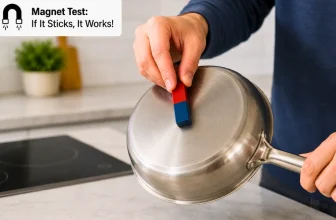
Quick Answer
Induction cooking does not damage cookware on its own. Damage usually comes from how induction heat is used rather than from the technology itself.
Rapid heat increases, empty preheating at high power, and poor pan-to-coil fit are the most common causes.
Induction amplifies mistakes because it heats quickly and directly, which rewards good habits and exposes weak ones.
How Induction Cooking Actually Heats Cookware
Induction cooking heats cookware through magnetic energy rather than a heated surface. When a compatible pan is placed on the cooktop, the pan itself becomes the heat source. This process is efficient and fast.
Because the heat is generated inside the pan base, temperature rises more quickly than on gas or traditional electric burners. This responsiveness is often described as precision, but it also means there is less margin for delay or correction.
A useful way to think about induction is to compare it to a sports car. It does not create danger by default, but it responds instantly to input. Gentle acceleration feels smooth. Abrupt acceleration feels harsh. The outcome depends on how the controls are used.
This direct heating explains why induction can reveal cookware limitations sooner. Thin bases, uneven construction, or stressed coatings reach their limits faster under rapid heat changes. The cooktop is not harsher. It is simply more honest.
Understanding this mechanism helps explain why damage patterns on induction often overlap with cookware warping and why technique matters more than fear.
Why Induction Exposes Weaknesses in Cookware
Induction does not introduce new types of stress. It compresses them in time.
Rapid heat ramps increase thermal expansion quickly. If cookware materials or layers expand at different rates, stress builds. Well-constructed cookware absorbs this stress evenly. Poorly constructed cookware does not.
Empty cookware heats especially fast on induction. Without food or oil to absorb energy, temperatures can rise beyond intended limits in seconds. This condition stresses coatings, bonds, and base flatness.
Induction also makes fit more important. When a pan does not match the coil size, heat concentrates unevenly. The center may overheat while edges lag behind. Over time, this imbalance contributes to deformation.
Seen this way, induction acts like a stress test. It does not cause problems randomly. It reveals where cookware or habits fall short. Recognizing this relationship allows buyers to adjust technique rather than blame the cooktop.
This perspective aligns closely with signs your cookware is no longer safe to use, which focuses on predictability and structure rather than isolated incidents.
Common Induction Mistakes That Cause Damage

Most induction-related damage follows a few repeatable patterns. These mistakes are easy to make because induction feels effortless, but the consequences build quietly.
Preheating Empty Cookware on High Power
Empty cookware heats extremely fast on induction. Without food or oil to absorb energy, temperatures climb in seconds rather than minutes.
This rapid rise stresses the pan base and any surface coatings. Non-stick coatings degrade sooner. Thin metals expand unevenly. Over time, repeated empty preheating increases the risk of warping.
Starting with oil or food in the pan slows heat rise and spreads energy more evenly. This simple habit reduces stress without reducing performance.
Using Undersized or Poorly Fitting Cookware
Induction works best when the pan base closely matches the size of the induction coil. When cookware is too small or poorly centered, heat concentrates in the middle.
This concentration creates hot spots. The center expands faster than the edges, which encourages permanent deformation. Even sturdy cookware can suffer when this pattern repeats.
Proper fit supports even heating and preserves flatness, which directly affects long-term stability.
Sudden Power Spikes
Jumping from low to maximum power creates thermal shock. Metal expands quickly, then contracts as settings change. Repeated cycles fatigue the structure.
Gradual increases allow materials to adjust. This approach feels slower, but it often produces more consistent cooking and less stress on the pan.
Induction responds instantly. That responsiveness rewards smooth control more than aggressive adjustments.
Sliding Cookware Across the Cooktop
Sliding cookware across glass induction surfaces causes abrasion. Over time, this wears the pan base and can introduce micro-damage.
Lifting instead of sliding reduces this wear. The change is small, but the effect accumulates across months of use.
Materials Most Vulnerable to Induction Mistakes

Induction-related damage varies by cookware material because different constructions respond differently to rapid, concentrated heat, as outlined in Cookware Types Explained: Materials, Uses, and Limitations. Some materials tolerate induction stress better than others. Vulnerability depends more on construction than on material name.
Non-Stick Cookware
Non-stick cookware is sensitive to rapid heating. Coatings experience stress before the base metal does.
Empty preheating and high power settings accelerate coating breakdown. This pattern often leads to earlier replacement and aligns with guidance on when to replace non-stick cookware.
Thin Aluminum with Magnetic Discs
Some aluminum cookware relies on a bonded magnetic disc to work on induction. Heat transfer can be uneven if bonding quality is inconsistent.
The aluminum body expands differently than the disc. Over time, this mismatch encourages warping and separation.
Glass Cookware Used Improperly
Glass cookware is not designed for direct induction heating unless specifically engineered for it. When used incorrectly, thermal stress can cause cracking.
Even heat and gradual temperature changes matter more with glass than with metal.
Materials That Tolerate Induction Better
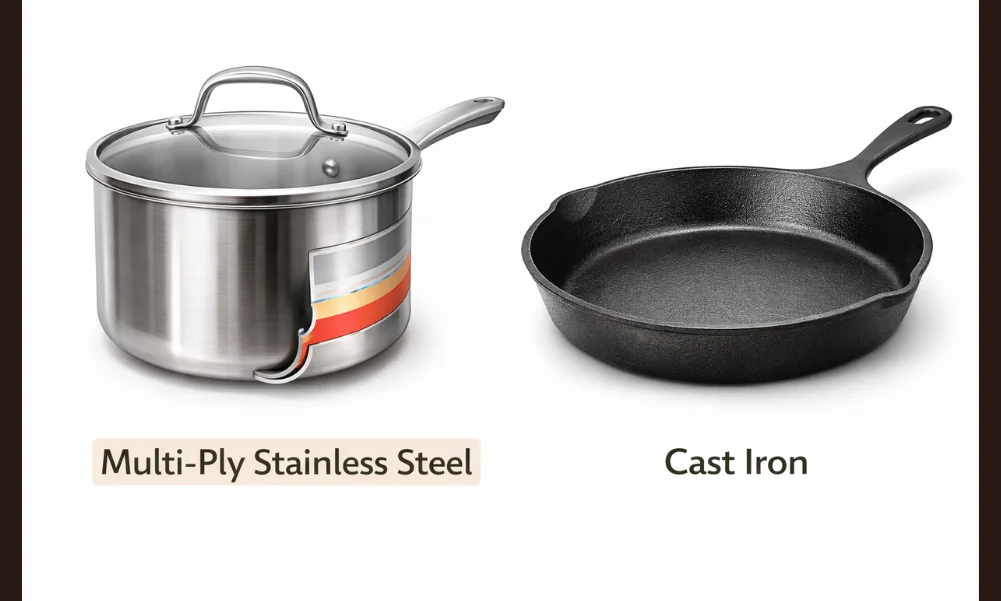
Well-constructed cookware handles induction stress predictably.
Multi-ply stainless steel distributes heat across layers, reducing hot spots. Cast iron absorbs heat slowly and resists deformation. Carbon steel balances responsiveness with durability when used with care.
In each case, construction quality matters more than marketing labels. Even heat flow protects structure.
What Induction Does Not Do
Induction does not damage cookware by default. It does not overheat pans automatically. It does not create safety issues without misuse.
When damage appears, it reflects how energy was applied rather than a flaw in the technology.
This distinction helps reduce misplaced concern and supports practical adjustments instead of avoidance.
Signs Induction Use Is Causing Damage
Persistent warping is the most common sign. Handles may loosen as repeated heat cycles stress attachment points. Cooking behavior may change as flatness is lost.
These signals overlap with broader signs your cookware is no longer safe to use, which focus on stability and predictability.
Recognizing these signs early allows changes in technique before replacement becomes necessary.
How to Use Induction Without Shortening Cookware Lifespan
Gradual heat increases reduce thermal shock. Matching pan size to coil size improves heat balance. Avoiding empty high-power preheats protects coatings and structure.
These habits do not reduce induction’s advantages. They simply align control with speed.
Induction Cooking as a Long-Term Care Factor
Induction rewards cookware with good construction and users with smooth technique. Over time, this pairing extends lifespan rather than shortens it.
Understanding how induction applies energy helps buyers choose cookware wisely and adjust habits realistically. This perspective fits naturally into expectations about cookware durability and care.
Closing Summary
Induction cooking does not damage cookware by itself. Damage comes from rapid heat changes, empty high-power preheating, and poor cookware fit.
Because induction heats quickly and directly, it exposes weaknesses sooner. Good technique and well-matched cookware prevent most problems.
By treating induction as a precision tool rather than a hazard, buyers can cook efficiently while preserving cookware performance and longevity.