Quick Answer
Riveted and welded cookware handles can both be durable when properly designed. Riveted handles rely on mechanical fasteners that distribute load through the pan wall, while welded handles are bonded directly to the cookware body. Longevity depends more on construction quality, material thickness, and heat exposure than on the attachment method alone. Each approach has predictable strengths and failure modes that affect long-term reliability.
What Riveted and Welded Handles Are
Cookware handles are attached in one of two primary ways: mechanical fastening or bonding. The method used affects how stress is transferred from the handle into the body of the pan.
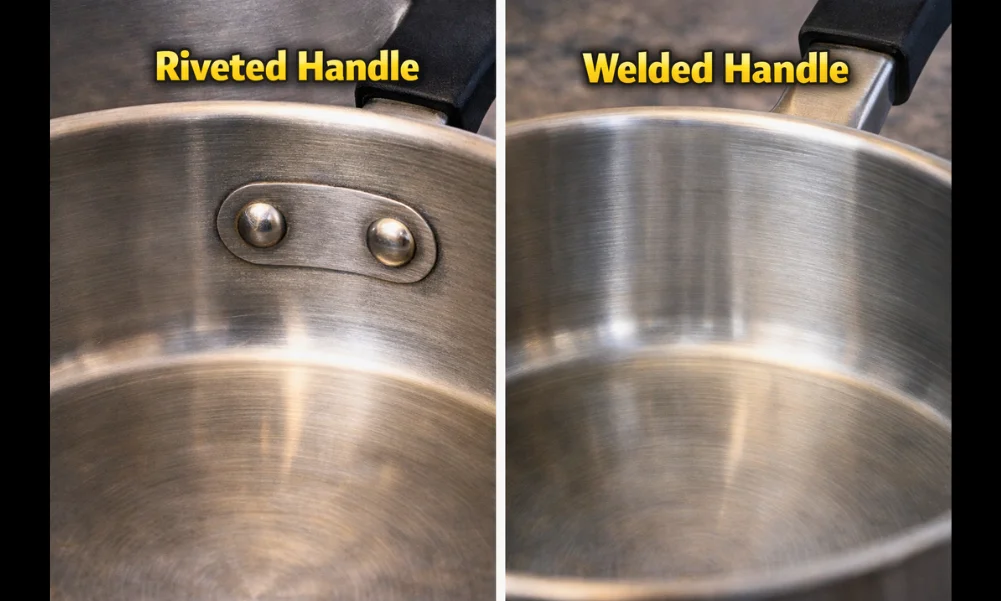
Riveted handles are secured using metal fasteners that pass through the cookware wall and are flattened or locked in place. These fasteners create visible rivet heads inside the pan and anchor the handle by clamping it to the cookware body.
Welded handles are attached by fusing the handle base to the cookware surface, typically through spot welding. This creates a smooth interior surface with no visible fasteners.
Both approaches aim to solve the same problem: keeping a handle securely attached under repeated lifting, heating, cooling, and load changes. The difference lies in how forces are distributed and how the attachment ages over time.
How handles are attached is one part of overall cookware construction, which also includes materials, thickness, and intended use, as explained in Cookware Types Explained: Materials, Uses, and Limitations.
A useful way to think about the distinction is that rivets hold the handle in place, while welds become part of the cookware body. Each strategy manages stress differently, which shapes how and when problems appear.
Riveted Handles Explained
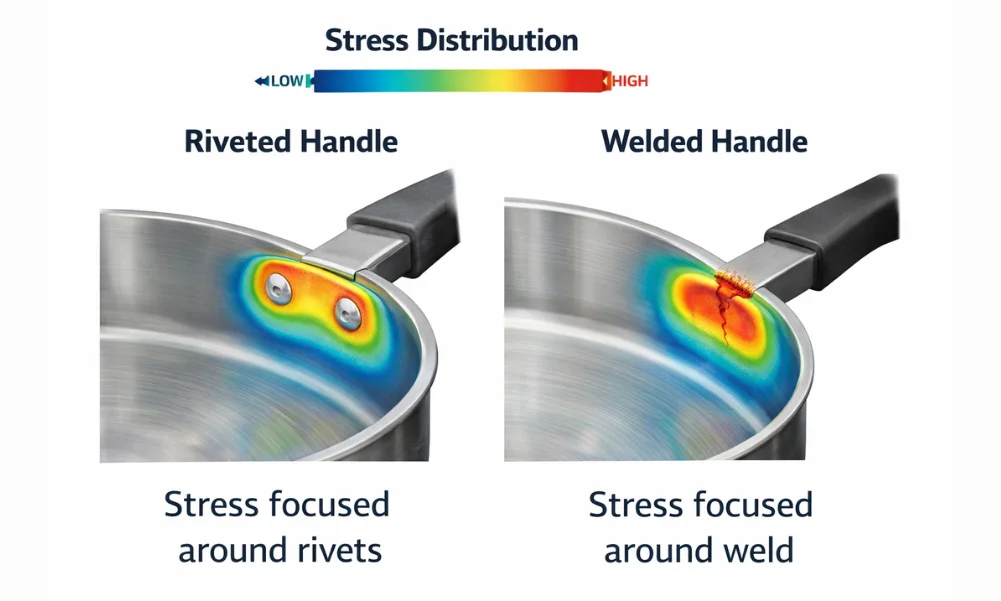
Riveted handles use mechanical attachment to spread load across multiple contact points. When a pan is lifted, the force travels from the handle through the rivets and into the cookware wall.
This approach has two advantages. First, rivets tolerate repeated heating and cooling well because they are not dependent on a single bonded joint. Second, when properly installed, rivets distribute stress rather than concentrating it in one area.
The main limitation of riveted handles is that they introduce penetration points through the cookware wall. Over time, repeated stress can cause rivets to loosen slightly, especially on heavy cookware or large pans. This loosening is usually gradual and detectable rather than sudden.
From a longevity perspective, riveted handles tend to fail slowly rather than catastrophically. That makes problems easier to notice and address before safety is compromised.
Welded Handles Explained
Welded handles are attached by bonding the handle base directly to the cookware body, usually through spot welding. This process fuses the metals at specific contact points, creating a fixed connection without penetrating the cookware wall.
One advantage of welded handles is interior smoothness. Without rivet heads inside the pan, cleaning is simpler and food buildup is reduced. This design also eliminates potential seepage points, which can matter in cookware used for liquids or sauces.
The durability of welded handles depends heavily on weld quality and surface area. A well-executed weld distributes stress across a sufficient contact zone and can remain stable for many years. A poorly executed weld concentrates stress in a small area, increasing the risk of fatigue or cracking under repeated load and heat cycling.
Unlike rivets, welded joints do not loosen gradually. When problems develop, they tend to appear as cracks at the weld point or sudden separation. This makes inspection more important, since failure may not be preceded by obvious warning signs.
Durability and Failure Modes
Both riveted and welded handles experience stress from three primary sources: weight, heat, and motion. How each attachment method responds to that stress determines its long-term reliability.
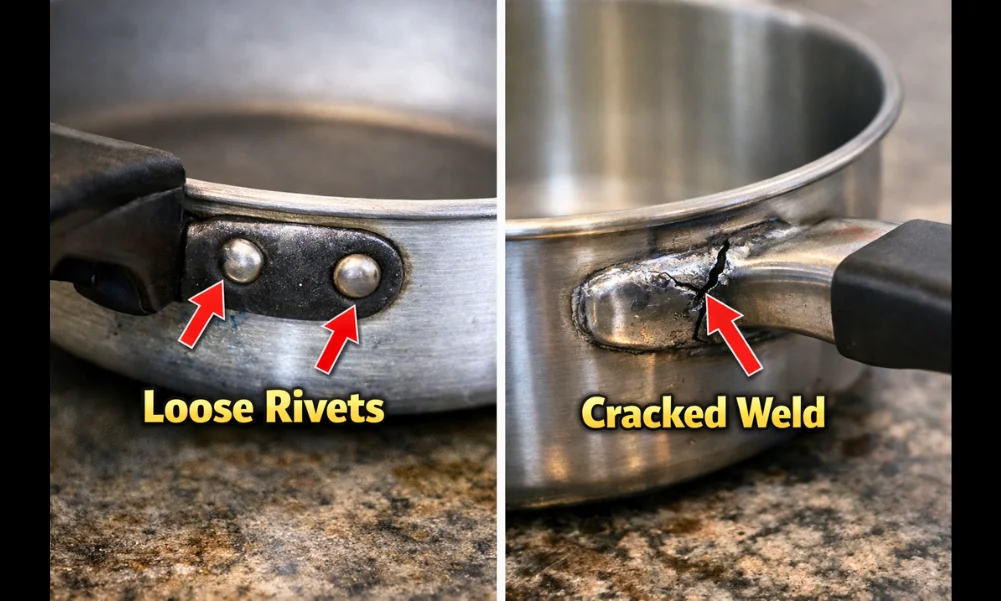
Riveted handles typically fail through loosening. As the pan is lifted repeatedly, microscopic movement can occur around the rivet holes. Over time, this can lead to handle wobble. While inconvenient, this type of failure is usually progressive and detectable.
Welded handles fail through fatigue or fracture at the weld joint. Thermal expansion and contraction place repeated strain on the bonded area. If the weld is small or uneven, cracks can form and propagate. When separation occurs, it is often abrupt.
Neither failure mode is inherently worse. The difference lies in predictability. Riveted handles tend to give warning through movement. Welded handles rely more on initial manufacturing quality and ongoing inspection.
Handle length and pan size also matter. Longer handles and heavier cookware amplify stress regardless of attachment method. In these cases, attachment quality outweighs design preference.
Safety and Long-Term Reliability
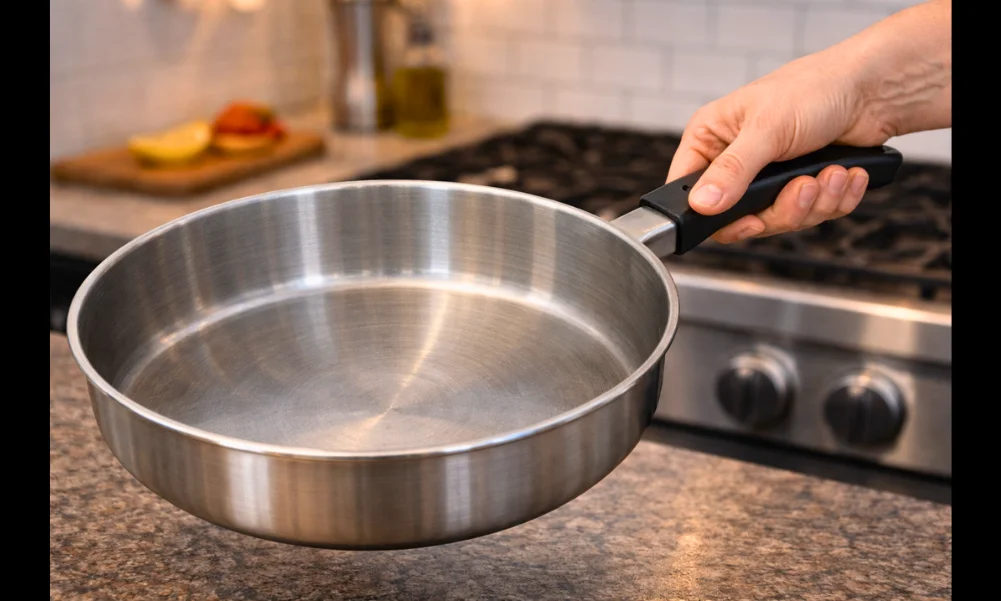
Handle attachment affects safety because it bears the full weight of hot cookware. Reliability depends on how well the attachment method matches the cookware’s intended use.
Large pans, stockpots, and cookware designed for oven use benefit from attachment methods that tolerate sustained load and repeated heat cycles. Smaller pans and lighter cookware place less stress on handle joints and are less sensitive to attachment differences.
Storage methods can also affect handle stress over time, especially when cookware is hung by the handle, a factor discussed in Cookware Hooks vs Racks: Which Storage Option Works Better.
Regular inspection is part of safe ownership. Loose rivets or visible weld cracks indicate that a pan should no longer be used until repaired or replaced. Ignoring early signs increases risk regardless of attachment type.
A practical buyer takeaway is that handle attachment should be evaluated alongside pan weight, handle length, and cooking habits, not as an isolated feature.
Which Handle Type Lasts Longer in Practice
In real kitchens, neither riveted nor welded handles consistently outlast the other across all scenarios. Longevity depends on execution rather than concept.
High-quality riveted handles can last decades without meaningful degradation. High-quality welded handles can do the same. Problems arise when either method is poorly implemented or mismatched to the cookware’s size and weight.
Riveted handles tend to offer greater tolerance for heavy loads and long-term stress. Welded handles offer cleanliness and simplicity when properly engineered. The deciding factor is not the label, but the quality of materials, attachment area, and intended use.
Handle longevity also fits into wider expectations about cookware lifespan, which vary by material and construction, as outlined in How Long Should Cookware Last (By Material Type).
Closing Summary
Riveted and welded cookware handles solve the same problem using different strategies. Rivets rely on mechanical fastening and tend to fail gradually. Welds rely on bonded joints and depend strongly on manufacturing quality.
Neither method is universally superior. Handle longevity is shaped by cookware weight, heat exposure, construction quality, and user habits. Buyers benefit most from understanding how each attachment behaves over time rather than assuming one is always better.