


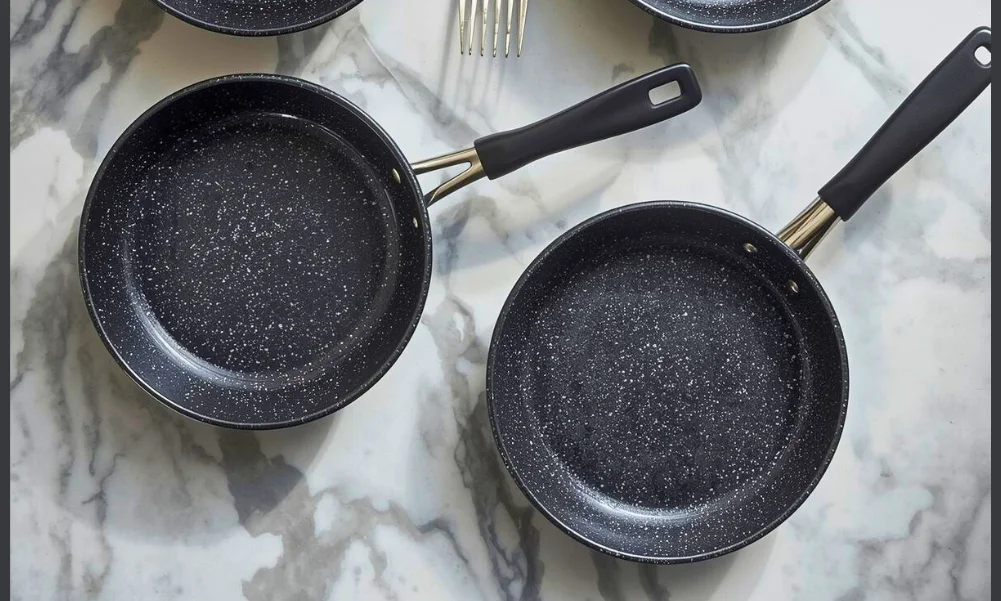
Granite cookware is not made from granite stone. Despite the name, granite cookware does not contain granite stone and does not behave like stone cookware. It is typically aluminum cookware coated with a nonstick surface that contains mineral fillers to create a stone-like appearance.
Most granite cookware uses a modern PTFE-based coating that is PFOA-free, with safety and performance depending on heat control, coating condition, and care practices. Its durability is limited by the lifespan of the nonstick coating rather than the base material.
What Granite Cookware Actually Is
Granite cookware is a name, not a material definition. In cookware labeling, “granite” describes how a pan looks and how it is positioned, not what it is made from.
At its core, granite cookware is coated cookware. The cooking surface is a synthetic nonstick layer applied to a metal base, most often aluminum. Mineral or ceramic particles are added to the coating to create a speckled, stone-like texture. These particles influence appearance and surface feel, but they do not turn the pan into stone cookware.
This distinction is important for buyers. Materials such as cast iron or stainless steel describe the substance that directly affects heat behavior, durability, and long-term performance. Granite cookware does not function as a standalone material category, which aligns with how cookware categories are defined in Cookware Types Explained. It behaves like nonstick cookware because that is what it is.
A useful way to think about granite cookware is as nonstick cookware wearing a stone-patterned jacket. The exterior impression may suggest ruggedness or natural materials, but the cooking experience is governed by the same rules that apply to other coated pans.
Typical Construction of Granite Cookware
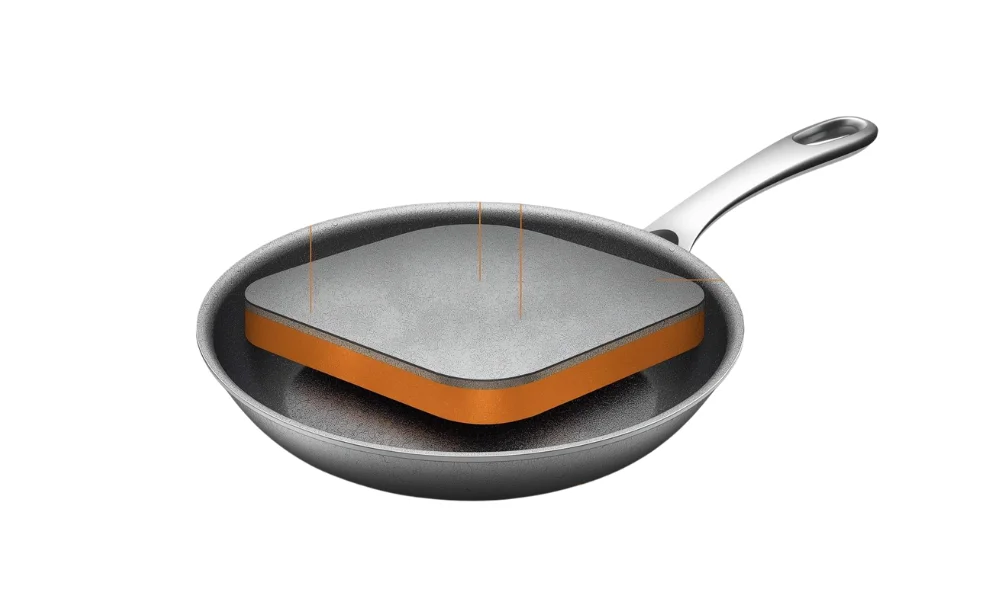
Granite cookware follows a relatively consistent construction pattern across manufacturers, even when marketing language differs.
Base Metal
Most granite cookware uses aluminum as its base. Aluminum is widely used in coated cookware because it heats quickly, distributes heat evenly, and keeps cookware lightweight. These traits suit everyday cooking tasks such as sautéing, simmering, and pan-frying at moderate temperatures.
Some granite-style cookware uses stainless steel or carbon steel as a base, but this is less common. When it does occur, the cooking behavior still depends heavily on the coating rather than the metal beneath it.
The base metal determines how heat enters the pan. The coating determines how the food interacts with the surface.
Coating System
The cooking surface is typically a PTFE-based nonstick coating that includes mineral fillers. These fillers may be marketed as “granite,” “stone,” or “mineral-reinforced,” but they do not replace the underlying nonstick chemistry.
In practical terms, the fillers can slightly increase surface texture and visual depth. They do not eliminate the core limitations of nonstick coatings. Release performance, heat tolerance, and wear resistance remain tied to coating thickness, formulation quality, and usage conditions.
Modern PTFE coatings used in granite cookware are manufactured without PFOA. This reflects current regulatory standards rather than a unique feature of granite-labeled products.
Is Granite Cookware Safe to Use?
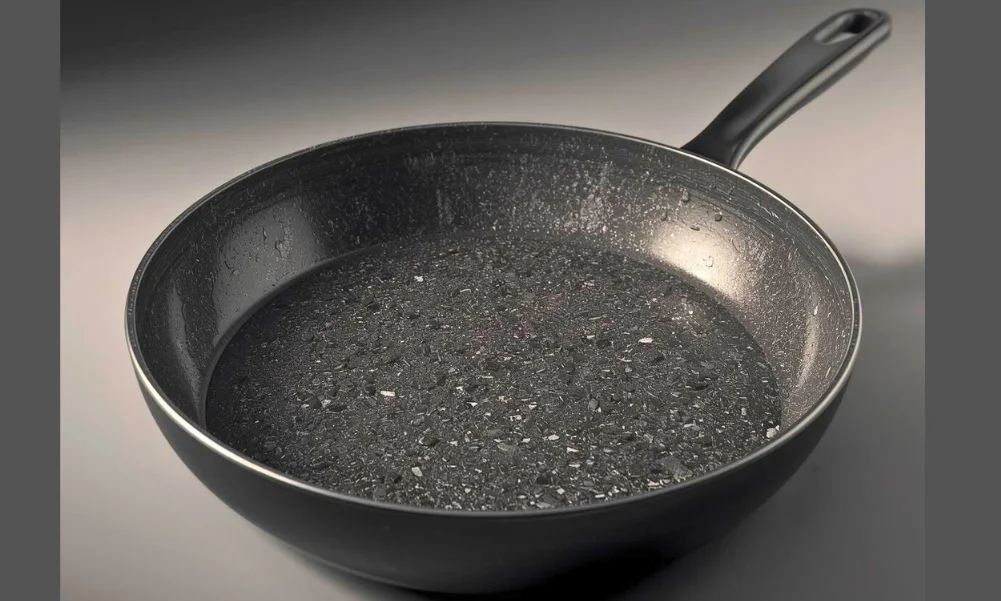
Granite cookware safety is best understood in terms of how it is used, not how it is named. The materials involved are familiar, and their behavior is well documented when handled within intended limits.
Most granite cookware uses a modern PTFE-based nonstick coating that is manufactured without PFOA. This reflects industry-wide changes that have been in place for years rather than a special property of granite-style cookware. When used at normal cooking temperatures, these coatings are considered stable and widely used across home kitchens.
Safety concerns arise when nonstick cookware is overheated or significantly worn. PTFE coatings can degrade if exposed to temperatures well above typical stovetop cooking ranges. At the same time, a scratched or peeling surface signals that the coating is no longer performing as designed. In both cases, the issue is not granite specifically, but the limits of nonstick coatings as a category.
From a buyer perspective, granite cookware is safest when treated as medium-heat cookware. It is well suited to everyday tasks such as eggs, vegetables, grains, and gentle pan-frying. It is not designed for prolonged high-heat searing, empty preheating, or oven use beyond manufacturer guidelines.
A helpful mental model is to treat granite cookware like a precision surface rather than a rugged one. It performs well when respected, but it is not forgiving of misuse.
Heat Performance and Cooking Behavior
Granite cookware heats primarily according to its aluminum base. Aluminum responds quickly to changes in burner output, which allows for good temperature control during routine cooking. This responsiveness is one of the main reasons aluminum is paired with nonstick coatings.
At the same time, the nonstick surface acts as a limiting layer. Granite cookware does not tolerate extreme heat well, even if the aluminum beneath it could physically handle higher temperatures. High heat can shorten coating life and reduce nonstick performance over time.
Compared to uncoated cookware, granite cookware excels at low to medium heat consistency. Food releases easily, and cleanup is minimal when the coating is intact. However, it does not develop fond, and it does not reward high-temperature techniques.
In practice, granite cookware performs best when the goal is efficiency rather than intensity. It favors control over power and consistency over versatility.
Durability and Realistic Lifespan
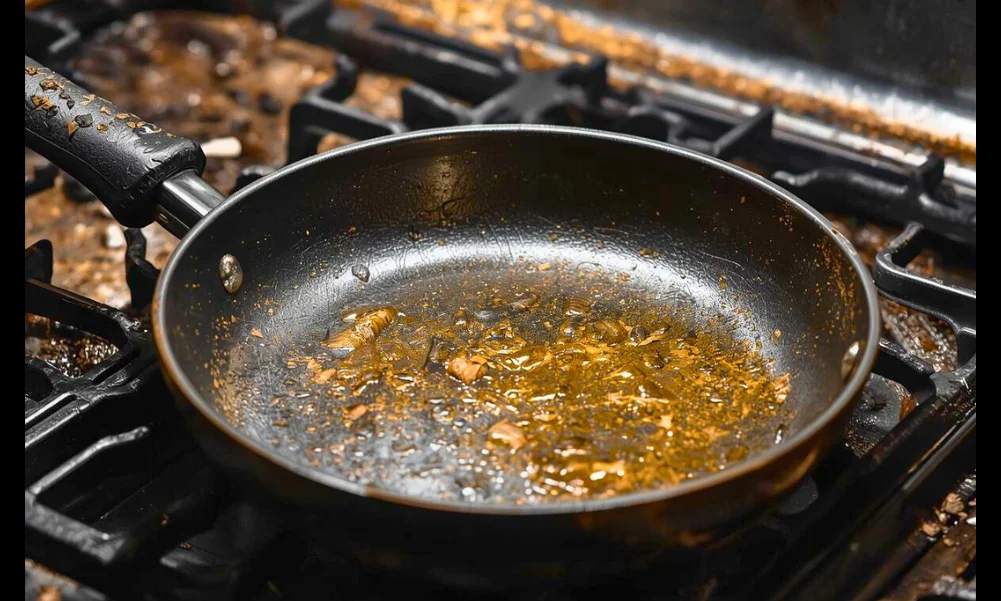
Durability is where granite cookware requires the most honest expectations. The limiting factor is not the metal body, but the nonstick coating itself.
Even with mineral reinforcement, nonstick coatings wear with use. Utensil contact, repeated heating cycles, and cleaning abrasion gradually reduce release performance. The stone-like appearance does not prevent this process. It can sometimes mask early wear, but it does not stop it.
For most households, granite cookware offers short to moderate-term durability. This lifespan aligns with expectations discussed in how long should cookware last, where coated cookware is evaluated by performance decline rather than appearance. With careful use, it can perform well for several years. With heavy use or high heat, that lifespan shortens noticeably.
This does not make granite cookware a poor choice. It makes it a purpose-specific tool. Buyers who expect decade-long durability may be better served by uncoated materials. Buyers who prioritize easy release and low maintenance often find granite cookware acceptable, provided expectations are aligned.
Maintenance and Care Requirements
Granite cookware remains functional longer when care practices align with the limits of nonstick coatings. While the surface is designed to reduce sticking, it is not designed to resist abrasion or thermal stress indefinitely.
Cleaning should be done with non-abrasive sponges and mild detergents. Aggressive scrubbing removes small amounts of coating over time, even when no damage is immediately visible. Dishwashers accelerate this wear through heat, detergents, and water pressure, which is why hand washing is generally recommended for coated cookware.
Utensil choice also affects longevity. Wood, silicone, or nylon utensils reduce surface contact stress compared to metal tools. Storage matters as well. Stacking pans without protection introduces repeated friction that slowly degrades the coating.
A practical way to think about maintenance is to treat granite cookware as low-effort during cooking but high-awareness between uses. The convenience appears on the stove. The preservation happens afterward.
Granite Cookware Compared to Related Categories
Granite cookware often overlaps with other nonstick categories, which can make comparisons confusing. Looking at construction rather than labels helps clarify where it fits.
Granite vs Ceramic Cookware
Both granite and ceramic cookware are frequently marketed as “natural” or “stone-inspired,” yet most products in both categories are coated metal pans. Ceramic cookware typically uses a silica-based coating instead of PTFE.
Ceramic coatings are PTFE-free by formulation, but they tend to lose nonstick performance more quickly under regular use. Granite cookware, which usually relies on PTFE, often maintains release properties longer when used within heat limits.
The tradeoff is heat sensitivity. Both coatings degrade with excessive heat, but ceramic surfaces are generally less forgiving over time.
Granite vs Traditional PTFE Nonstick
Functionally, granite cookware and traditional nonstick cookware behave very similarly. Both rely on PTFE chemistry for food release. The main difference lies in texture and presentation, not core performance.
Granite-style coatings may feel slightly more textured and appear more durable. In practice, lifespan and performance depend more on coating thickness and care than on surface appearance.
Safety considerations for PTFE-based coatings are explored in is Teflon-coated cookware still safe to use, where proper heat use and surface condition matter more than coating labels.
Granite vs Enameled Cast Iron
Enameled cast iron occupies a different category entirely. It is heavier, slower to respond to heat changes, and designed for long cooking sessions. The enamel surface is durable but not nonstick in the same way.
Granite cookware prioritizes ease of use and quick cleanup. Enameled cast iron prioritizes heat retention and long-term durability. Choosing between them depends on cooking style rather than perceived quality.
Who Granite Cookware Is Best Suited For
Granite cookware suits cooks who value convenience, controlled heat, and easy cleanup. It works well for everyday meals where sticking is a frustration rather than a technique.
It is less suited to cooks who frequently use high heat, metal utensils, or expect cookware to last for decades. In those cases, uncoated materials provide more resilience with fewer constraints.
Granite cookware performs best when expectations are realistic. It is a comfort tool, not a forever tool.
Evaluating Common Granite Cookware Claims
Marketing language around granite cookware often emphasizes natural materials, enhanced durability, or superior safety. These claims should be interpreted carefully.
Mineral fillers do not turn nonstick cookware into stone cookware. Phrases such as “stone-derived” or “rock coating” describe appearance, not composition. Safety claims usually reflect standard compliance rather than unique properties.
A useful rule is to focus on what is disclosed rather than what is implied. Clear information about coating type, heat limits, and care instructions is more meaningful than descriptive names.
How Granite Cookware Fits into the Cookware Landscape
Granite cookware belongs within the nonstick category, not alongside foundational materials such as stainless steel or cast iron. It offers a balance of convenience and control, with tradeoffs in durability and heat tolerance.
For buyers researching cookware materials, granite cookware is best evaluated as one option among coated pans. Understanding its construction and limits allows it to be used effectively without inflated expectations.
When chosen for the right reasons and used with care, granite cookware can be a practical part of a home kitchen. When chosen for the wrong reasons, it often disappoints. The difference lies in understanding what the label does and does not mean.
